Author: King

  • AZETHIO Addresses $217 Billion in First-Half 2025 Exchange Breaches with Multi-Party Computation Custody for US Traders

    U.S.-registered exchange introduces institutional-grade asset protection as 63% of Americans lack confidence in cryptocurrency security

    AZETHIO CRYPTO GROUP LIMITED, a U.S.-registered digital asset exchange, has launched its trading platform designed to address security concerns affecting American cryptocurrency traders. With cryptocurrency exchange breaches reaching $21.7 billion in losses during the first half of 2025—including the $1.5 billion Bybit incident attributed to state-sponsored threat actors by U.S. federal authorities—and 63% of U.S. adults lacking confidence in cryptocurrency safety and reliability, the platform introduces Multi-Party Computation (MPC)-based custody infrastructure targeting the specific security requirements identified through market analysis.

    The North American market, which processed approximately $1.3 trillion in cryptocurrency transactions between July 2023 and June 2024—representing 22.5% of global activity—faces persistent trust challenges. According to Pew Research Center data from October 2024, the majority of U.S. adults remain concerned about the reliability of digital asset platforms. These concerns intensified as CertiK’s quarterly reports documented over 340 security incidents across Q1 and Q2 of 2025, with losses declining to $509 million in Q3 yet demonstrating ongoing vulnerability within centralized platforms.

    Addressing Asset Protection Requirements Through Multi-Layer Infrastructure

    The platform centers on security priorities identified through analysis of U.S. market requirements. AZETHIO implements Multi-Party Computation for cryptographic key management, distributing control across multiple parties to eliminate single points of failure—meaning no individual can access user funds independently. The system combines MPC-based custody with hardware security modules and geo-distributed infrastructure spanning U.S., European, and Asian regions, providing automated failover capabilities.

    Cold storage infrastructure maintains the majority of assets in offline environments, reducing exposure to network-based attack vectors. Monthly Proof-of-Reserves publications enable traders to independently verify that deposited funds remain fully backed through on-chain attestations, addressing transparency concerns that emerged following industry incidents including the February 2025 Bybit breach that FBI investigations attributed to North Korean-linked groups.

    Real-time transaction monitoring integrates blockchain address risk scoring and automated Anti-Money Laundering protocols aligned with FinCEN guidance for Virtual Currency exchanges. The platform operates under U.S. regulatory frameworks, with KYC verification processes averaging completion times in line with industry-standard identity verification providers.

    What U.S. Traders Gain Access To

    American traders benefit from:

    • Distributed key control: MPC architecture prevents unauthorized access to assets through mathematical key distribution across multiple secure environments
    • Verifiable reserves: Monthly on-chain Proof-of-Reserves enabling independent confirmation of platform solvency through blockchain transparency
    • Regulatory alignment: Operations under U.S. compliance frameworks including FinCEN Virtual Currency guidance and Bank Secrecy Act requirements
    • Institutional-grade performance: Trading engine processing 1.2 million transactions per second with sub-1.5 millisecond order execution latency
    • Accessible verification: Streamlined identity verification aligned with current e-KYC provider capabilities, reducing onboarding friction for compliant users

    Compliance Framework for U.S. Market Requirements

    Operating under U.S. regulatory oversight, AZETHIO maintains compliance with FinCEN guidance for Convertible Virtual Currency businesses, requiring registration as a Money Services Business, implementation of comprehensive Anti-Money Laundering programs, and adherence to the Travel Rule for cross-border transactions. The platform implements automated Suspicious Activity Report monitoring and Currency Transaction Report filing procedures aligned with Bank Secrecy Act mandates.

    Security infrastructure undergoes regular third-party audits, with ISO/IEC 27001 and SOC 2 Type II certification frameworks guiding operational controls. User data protection follows GDPR and California Consumer Privacy Act requirements, with optional privacy-preserving verification methods under development.

    With regulatory momentum in the United States—including SEC’s shift toward rule-making frameworks in 2025, the closure of enforcement actions against major platforms like Coinbase and Robinhood Crypto, and approval of Bitcoin and Ethereum spot ETFs in 2024—American traders require platforms combining transparent operations with technical reliability. AZETHIO addresses this requirement by providing infrastructure where compliance monitoring, asset custody, and performance capabilities operate as integrated systems rather than separate components.

    The platform currently supports spot trading, staking services, and fiat-to-cryptocurrency conversion through licensed payment partners. Trading pairs cover major digital assets with plans for derivatives products following completion of additional compliance reviews. Mobile and web applications provide access to real-time market data, portfolio analytics, and security controls including withdrawal address whitelisting and device-based authentication.

    About AZETHIO

    AZETHIO CRYPTO GROUP LIMITED is a U.S.-registered digital asset exchange providing cryptocurrency trading infrastructure. The platform combines Multi-Party Computation custody, Proof-of-Reserves transparency, and regulatory compliance frameworks. Operating under FinCEN guidance and U.S. financial regulations, AZETHIO serves traders requiring institutional-grade security with accessible verification processes and transparent operational standards.

    Contact

    AZETHIO CRYPTO GROUP LIMITED 

    Samantha Brooks Chief Compliance Officer 

    samantha.brooks@ahclzdq.com 

    https://www.ahclzdq.com/ 

    Media Contact

    Organization: AZETHIO

    Contact Person: Samantha Brooks

    Website: https://www.ahclzdq.com/

    Email: Send Email

    Country:United States

    Release id:35948

    file

  • Bitquore Introduces Professional Trading Infrastructure for US Hedge Funds and Asset Managers

    Customized Liquidity Solutions and 1M+ TPS Infrastructure Target Growing Demand from Hedge Funds and Investment Firms

    Bitquore, a United States-registered cryptocurrency exchange, launched institutional trading services in Q2 2025 addressing infrastructure gaps for professional asset managers. With institutional crypto adoption rising from 25% in 2022 to 40% in 2025, demand for sophisticated trading infrastructure has accelerated following the SEC’s January 2024 approval of spot Bitcoin ETFs, which legitimized digital assets within traditional finance portfolios. This 15-percentage-point increase represents over $500 billion in new institutional capital entering digital asset markets, creating unprecedented demand for professional-grade trading infrastructure.

    The institutional trading landscape faces persistent challenges that deter larger capital deployment and create operational friction for established investment firms. Large-scale transactions on retail-focused exchanges often trigger significant price slippage, eroding returns for funds executing substantial positions. Industry data indicates that institutional orders exceeding $1 million frequently experience 2-5% slippage on conventional platforms, directly impacting fund performance metrics and creating hesitation among fiduciary managers.

    Liquidity fragmentation across platforms complicates execution strategies, requiring trading desks to maintain relationships with multiple exchanges and aggregate order flow manually. Limited API capabilities restrict algorithmic trading operations that institutional desks require for portfolio management across multiple asset classes. Many existing platforms lack the WebSocket support, order routing flexibility, and real-time market data feeds that quantitative trading strategies demand. These technical limitations force institutions to choose between operational efficiency and comprehensive market access.

    Infrastructure for Professional Trading Operations

    Bitquore’s institutional suite addresses three critical requirements identified by U.S. hedge funds and asset managers: execution efficiency, liquidity depth, and operational integration.

    The platform’s over-the-counter trading desks facilitate large-scale transactions with minimal market impact, enabling institutional clients to execute positions that would otherwise move prices on public order books. Dedicated account management provides customized settlement terms and personalized liquidity solutions tailored to each firm’s trading patterns and volume requirements. For asset managers executing regular rebalancing operations or funds building strategic positions, OTC desks eliminate the execution risk associated with public market orders while maintaining competitive pricing through direct market maker relationships.

    API access delivers the performance characteristics institutional trading operations demand. Built on infrastructure processing over 1 million transactions per second with sub-millisecond latency, the platform supports algorithmic strategies and high-frequency trading protocols. REST and WebSocket endpoints enable seamless integration with existing portfolio management systems, allowing firms to incorporate crypto assets alongside traditional holdings without operational restructuring. The API architecture supports order types familiar to institutional traders, including iceberg orders, time-weighted average price executions, and volume-weighted strategies, ensuring trading teams can implement sophisticated execution algorithms developed for traditional markets.

    Customized liquidity solutions address the capital deployment challenges that institutional investors face in fragmented markets. Strategic partnerships with market makers ensure consistent depth across 200+ trading pairs, while the matching engine maintains order book stability during volatile periods that typically challenge execution quality. For institutions managing portfolios with exposure across major cryptocurrencies and emerging tokens, consolidated liquidity access reduces operational complexity and improves execution outcomes.

    Compliance Framework for Institutional Standards

    Operating under FinCEN registration as a Money Services Business, Bitquore maintains compliance protocols aligned with institutional due diligence requirements. Multi-signature cold storage protects 95% of assets in geographically distributed offline environments, addressing security concerns that emerged from 2025’s $2.1 billion in industry theft losses. Third-party custody integrations and regular reserve audits provide the transparency that institutional investment committees require when evaluating platform risk.

    The regulatory environment supporting institutional participation continues strengthening. The SEC’s September 2025 streamlined listing procedures, reducing approval timelines from 240 days to 75 days, demonstrate regulatory momentum toward integrating digital assets into traditional finance frameworks. This clarity enables asset managers to allocate capital with greater confidence in operational and compliance stability. Additionally, ongoing discussions regarding stablecoin regulations and clearer tax treatment guidelines suggest that institutional-friendly frameworks will continue developing, reducing regulatory uncertainty that has historically limited institutional participation.

    Market Positioning and Growth Trajectory

    The U.S. institutional crypto market presents sustained growth opportunity as traditional finance firms expand digital asset exposure beyond Bitcoin to include Ethereum, layer-2 solutions, and tokenized real-world assets. Bitquore’s infrastructure serves hedge funds, family offices, and registered investment advisors requiring trading capabilities that combine institutional-grade security, professional execution tools, and regulatory compliance within a unified platform.

    With the derivatives market projected to expand from $1.8 billion in 2024 to $5.2 billion by 2033 at a 15.8% annual growth rate, institutional demand for sophisticated trading venues will intensify. Bitquore positions itself to capture this growth by delivering the professional infrastructure that asset managers require when integrating digital assets into multi-strategy portfolios.

    About Bitquore

    Bitquore is a United States-registered cryptocurrency exchange providing institutional trading services, including OTC desks, dedicated API access, and customized liquidity solutions. The platform combines high-performance infrastructure processing 1M+ transactions per second with FinCEN-compliant operations. Operating under U.S. Money Services Business registration, Bitquore serves professional asset managers requiring institutional-grade trading capabilities.

    Contact:
    Bitquore
    Institutional Services
    Client Relations 
    support@bitquore.com
    https://www.bitquore.com/

    Media Contact

    Organization: Bitquore

    Contact Person: Olivia Miller

    Website: https://www.bitquore.com/

    Email: Send Email

    Country:United States

    Release id:35953

    file

  • Cryptographic Key Shares NJTRX Implements Coordinated Signing Against Over 2 Billion USD Custody Vulnerabilities

    FinCEN-registered platform deploys distributed key architecture responding to $2.1B theft exposing centralized custody vulnerabilities

    United States, 23rd Oct 2025 – NJTRX Global Ltd., a FinCEN-registered Money Services Business, has implemented Multi-Party Computation (MPC) technology addressing centralized custody vulnerabilities that enabled $2.1 billion in losses affecting American traders during 2025’s first half. With approximately 60% of U.S. cryptocurrency holders citing platform security as their primary concern, the distributed architecture eliminates single-point compromise risks that characterized recent large-scale exchange breaches.

    The U.S. digital asset market, representing 100 million users and 40% of global trading volume, confronts escalating security challenges as theft incidents during 2025 have already surpassed 2024’s annual totals. Recent high-profile breaches exposed fundamental weaknesses in centralized key management systems where single compromised credentials, insider access, or administrative privilege abuse enabled catastrophic fund losses. Industry analysis reveals that traditional regulated exchanges, while maintaining an average 70% cold storage allocation, still operate centralized signing authority structures that create exploitable single-point vulnerabilities during transaction authorization processes.

    Distributed Cryptographic Architecture for American Traders

    NJTRX’s Aegis Security Protocol implements Multi-Party Computation technology that fundamentally restructures private key management by distributing cryptographic signing authority across multiple geographically separated secure facilities. Unlike traditional custody models where complete private keys exist in reconstructable form within single environments, the MPC infrastructure ensures no individual location or administrator ever possesses sufficient cryptographic information to independently authorize asset movement.

    The platform’s MPC implementation divides private keys into cryptographic shares distributed across isolated secure environments. Each participating facility maintains only partial key information mathematically insufficient for independent transaction signing. Transaction authorization requires coordinated cryptographic operations across multiple parties, with each location contributing its key share to collectively generate valid transaction signatures without ever transmitting, combining, or reconstructing the complete private key in any single location.

    This distributed approach directly addresses the insider threat vectors and single-administrator compromise scenarios that enabled recent exchange breaches. Where traditional systems granted privileged access to complete private keys for operational efficiency, NJTRX’s architecture ensures no individual—whether employee, contractor, or external attacker gaining system access—can independently authorize fund transfers. The cryptographic requirements for multi-party coordination create technical barriers preventing unauthorized asset movement even in compromise scenarios affecting individual system components.

    The MPC infrastructure operates in conjunction with 98% cold storage allocation using air-gapped, multi-signature wallets that maintain the vast majority of user assets in offline environments completely isolated from network access. For the remaining operational liquidity requiring more frequent transaction signing, Hardware Security Modules (HSMs) certified to FIPS 140-2 Level 3+ standards generate, store, and process key fragments within military-grade tamper-resistant environments. These hardware protections ensure cryptographic material never enters general-purpose computing systems vulnerable to software-based exploitation techniques.

    Zero-trust authentication protocols integrate throughout the architecture, treating every access request as potentially hostile regardless of origin or presented credentials. The Helios matching engine, processing institutional-grade transaction volumes, operates within security perimeters that require continuous verification rather than implicit trust assumptions based on network position or prior authentication. Real-time threat intelligence integration monitors emerging attack vectors while automated security controls respond to suspicious activity patterns.

    American investors benefit from comprehensive protection mechanisms:

    • Distributed key architecture: MPC technology eliminating single-point compromise vulnerabilities through cryptographic share distribution
    • Geographic facility separation: Key shares maintained across isolated secure locations preventing single-site compromise
    • Hardware-isolated key fragments: FIPS 140-2 Level 3+ certified modules protecting partial cryptographic information
    • Coordinated multi-party authorization: Transaction signing requiring cryptographic operations across independent secure facilities
    • Offline asset majority: 98% cold storage allocation significantly exceeding 70% industry average
    • Continuous authentication verification: Zero-trust protocols validating every system interaction
    • Real-time threat monitoring: Automated security intelligence detecting and responding to emerging risks

    The modular microservices architecture enables independent component scaling during market volatility periods while maintaining strict cryptographic isolation between system services. Each microservice operates within defined security boundaries with explicit authentication requirements, preventing lateral movement in potential compromise scenarios. Operating under U.S. federal MSB registration, NJTRX addresses custody requirements where American traders need protection against both external attack vectors and internal compromise scenarios including privileged access abuse.

    With U.S. cryptocurrency markets projected to reach $380 billion in daily trading volume throughout 2025, institutional and individual investors increasingly require platforms that eliminate architectural single points of failure. NJTRX’s distributed MPC implementation provides verifiable technical controls preventing unauthorized asset access within a federally-registered and state-incorporated compliance framework.

    About NJTRX

    NJTRX Global Ltd. is a U.S.-registered digital asset platform operating as a Money Services Business under FinCEN registration number 31000308516993. The company implements distributed Multi-Party Computation cryptographic architecture combined with 98% cold storage allocation, hardware security modules certified to FIPS 140-2 Level 3+ military-grade standards, and comprehensive zero-trust security protocols. The platform addresses institutional and individual custody requirements by eliminating single points of failure through geographic key share distribution, coordinated multi-party authorization requirements, and continuous authentication verification across all system interactions.

    Contact:
    NJTRX Global Ltd.
    Rhys Calder
    Chief Operating Officer
    Louisville, Kentucky
    rhys.calder@njtrx.com
    https://www.njtrx.com/

    Media Contact

    Organization: NJTRX

    Contact Person: Rhys Calder

    Website: https://www.njtrx.com/

    Email: Send Email

    Country:United States

    Release id:35950

    file

  • NKSCX Addresses Security Concerns of 63 Percent US Adults with Keyless Custody and FinCEN-Registered Infrastructure

    FinCEN-Registered Money Services Business Eliminates Seed Phrase Vulnerability Through Multi-Party Computation and Cryptographic Verification

    United States, 23rd Oct 2025 – As cryptocurrency investment fraud complaints filed with federal authorities surged from 69,000 cases in 2023 to losses exceeding $6.5 billion in 2024, NKSCX CRYPTO GROUP LTD has introduced infrastructure designed to address the trust deficit affecting nearly two-thirds of American adults interested in digital assets.

    Operating from its Denver headquarters under Money Services Business registration with the Financial Crimes Enforcement Network , the company targets what Pew Research identifies as a critical market gap: while 17% of U.S. adults have engaged with cryptocurrency, 63% express concerns about the safety and reliability of current platforms.

    Eliminating the Seed Phrase Vulnerability

    Traditional cryptocurrency wallets require users to safeguard a 12-24 word seed phrase—a single point of failure that, if lost or compromised, results in permanent asset loss. NKSCX’s platform eliminates this risk through keyless custody technology based on Ethereum’s ERC-4337 standard.

    The system replaces seed phrases with multi-factor authentication combining biometric verification, hardware security keys, and designated social recovery contacts. Users who lose access to their primary device can regain account control through pre-authorized trusted individuals or institutions, introducing what the company calls a “human safety net” to digital asset security.

    Institutional-Grade Custody Architecture

    The platform’s custody infrastructure employs Multi-Party Computation (MPC) protocols, distributing cryptographic key fragments across geographically separated servers. This eliminates single points of failure while maintaining transaction efficiency—a balance previously available only to institutional investors managing eight-figure portfolios.

    Real-time transparency comes through cryptographic verification protocols. Users can confirm that their deposited assets remain fully backed without exposing individual account balances or transaction histories. This verification publishes proofs that any third party can independently validate, addressing opacity concerns that emerged following high-profile exchange failures.

    Simplifying Complex Operations

    Where traditional decentralized finance requires users to manually navigate token swaps, bridge transactions, liquidity provisioning, and position monitoring across multiple protocols, NKSCX’s platform reduces this to natural language instructions.

    A user expressing the goal “earn optimal yield on stablecoins with moderate risk” triggers automated analysis of dozens of protocol options. The system identifies the most efficient path, bundles the required transactions, and executes them automatically. Operations that previously demanded technical expertise and constant attention now require a single instruction.

    Market Context

    The timing aligns with structural changes in U.S. crypto markets. CME Group reported regulated crypto derivatives reached $13.7 billion in average daily volume during Q3 2025, while the January 2024 approval of spot Bitcoin ETFs has channeled institutional capital through compliant vehicles. NKSCX positions its infrastructure at this intersection of growing institutional participation and persistent retail access barriers.

    The platform currently serves accredited investors and family offices, with compliance protocols including automated reporting for tax jurisdictions and granular permission controls for advisors managing client portfolios.

    About NKSCX CRYPTO GROUP LTD

    NKSCX CRYPTO GROUP LTD is a Colorado-registered Money Services Business providing institutional-grade digital asset infrastructure. Operating under FinCEN oversight, the company combines proprietary blockchain technology, keyless custody solutions, and cryptographic verification to deliver autonomous wealth management tools for sophisticated investors.

    Media Contact:

     NKSCX CRYPTO GROUP LTD

     Alistair Finch, Chief Strategy Officer 

    alistair.finch@nkscx.com 

    https://www.nkscx.com/

    Media Contact

    Organization: NKSCX

    Contact Person: Alistair Finch

    Website: https://www.nkscx.com/

    Email: Send Email

    Country:United States

    Release id:35925

    file

  • Turin Scientology Volunteers Revive Dora Station with The Way to Happiness

    Every Sunday morning in Turin, volunteers have been gathering at the former Dora station to clean parks, sidewalks, and streets — transforming neglected spaces into symbols of community pride. Led by the Procivicos association and inspired by L. Ron Hubbard’s The Way to Happiness, the initiative combines environmental action with moral education, promoting values of respect, friendship, and solidarity across the city.

    Turin Volunteers Revive Dora Station and Surrounding Districts with Weekly Cleanups Inspired by “The Way to Happiness”

    Turin, Italy — October 23, 2025 — Every Sunday morning, volunteers gather at the former Dora railway station in Turin to pick up litter and revitalize their surroundings. What started as a small local effort has become a consistent movement of civic renewal across the city’s northern districts, including Borgo Vittoria, Barriera di Milano, Borgata Parella, and Le Vallette.

    Armed with gloves, tongs, and trash bags, the volunteers remove cigarette butts, bottles, cans, and other debris from streets, parks, and green areas. The initiative, coordinated by the civic association Procivicos, (Civil Protection by the Church of Scientology) is driven by a belief that caring for one’s environment is a shared duty.

    “Every Sunday at nine o’clock, we meet near the old Dora station and then move through different parts of the city,” explained Procivicos president Beppe Tesio. “Our aim is not only to clean but to create awareness. Each piece of litter we collect is a small reminder that everyone can make a difference.”

    Cleaning the City — and the Spirit

    While the volunteers’ work has visible environmental results, it also carries a moral dimension. Their inspiration comes from The Way to Happiness, a common-sense guide written by humanitarian and author L. Ron Hubbard. The booklet, translated into 112 languages, outlines 21 precepts promoting ethical living, respect, and cooperation.

    Tesio explains: “Every Friday evening we hold meetings based on The Way to Happiness. These gatherings are open to anyone — not just those carrying out public service — who wants to reflect on values such as respect, friendship, and brotherhood. In a time when division often dominates, these reminders help us reconnect with what truly unites people.”

    Through these discussions and cleanups, Procivicos fosters both practical and personal change. Participants find that acting together for a cleaner city strengthens social ties and encourages empathy — values that extend beyond any single neighborhood.

    A Model of European Civic Engagement

    The initiative has drawn positive attention for embodying civic participation and community cooperation — ideals central to European life.

    Ivan Arjona, representative of the Church of Scientology to the European Union, OSCE, Council of Europe, and United Nations, praised the volunteers’ spirit:

    “This kind of community work perfectly embodies the European spirit of responsibility and solidarity. It shows that improving our environment and our relations with one another are two sides of the same coin. The message contained in The Way to Happiness is universal — it reminds us that through simple, ethical actions, each person can contribute to the well-being of society as a whole.”

    Arjona noted that grassroots initiatives like this are essential complements to public policies on environmental protection and social cohesion. “When citizens come together voluntarily to care for their surroundings, they reaffirm the very foundation of Europe’s democratic values,” he added.

    Visible Impact and Open Participation

    Over the months, the Dora Station cleanup project has visibly improved local conditions. Streets once cluttered with litter are now welcoming spaces where families can walk safely. Children play in cleaner parks, and the atmosphere of shared responsibility has spread to nearby districts.

    Participation remains open to everyone. Volunteers include residents, students, retirees, and people performing community service. All share the same motivation: to make Turin more beautiful and foster a sense of belonging.

    The group’s activities also extend to environmental education. During their weekly meetings, members discuss the long-term effects of pollution and the importance of daily choices — from recycling habits to community respect.

    About The Way to Happiness

    The Way to Happiness, written by L. Ron Hubbard, is a non-religious moral guide composed of 21 principles for living with integrity, care, and respect. Since its first publication in 1981, it has reached more than 200 countries and is used by educators, community leaders, and civic organizations to promote honesty, tolerance, and responsibility toward others and the environment.

    About the Church of Scientology

    The Church of Scientology, its missions, and community groups are active across the European continent, supporting initiatives that advance education, human rights, and ethical living. Recognized as a charitable and bona fide religion in several European nations, the Church continues its commitment to promoting understanding, civic engagement, and social betterment.

    Media Contact

    Organization: European Office Church of Scientology for Public Affairs and Human Rights

    Contact Person: Ivan Arjona

    Website: https://www.scientologyeurope.org

    Email: Send Email

    Address:Boulevard de Waterloo 103

    City: Brussels

    State: Brussels

    Country:Belgium

    Release id:35907

    file

  • RZ Ecosystem and Meta Games Coin MGC Join Forces to Redefine Blockchain Utility in Gaming and Finance

    Dubai, UAE – In the latest development, the innovative collaboration is set to reshape the future of digital economies, RZ Ecosystem and Mets Gmes Coin (MGC) have announced a strategic partnership designed to merge blockchain-based gaming innovation with advanced decentralized finance. This alliance aims to create a cohesive, interoperable environment where digital assets, gaming rewards, and al-world financial utilities coexist seamlessly – marking a new era of cross-industry blockchain integration. 

    Meta Games Coin (MGC) is a pioneering BEP-20 token powering a comprehensive gaming and entertainment ecosystem. Designed to unify digital, physical, and Play-to-Earn (P2E) experiences, MGC serves as the primary currency for transaction, payments, and rewards across multiple platforms. 

    Through its AI-powered ranking a performance tracking, MGC bridges fragmented gaming platform and provides players with a unified transparent ranking system. By integration cloud gaming and universal token transfers, MGC removes traditional hardware and exchange barriers – ensuring inclusivity, consistency, and global accessibility. 

    RZ Coin, the native token of the RZ Blockchain, acts as the financial backbone of the RZ Ecosystem – a decentralized network that enables secure, transparent, and efficient transactions cross industries. Built on cutting edge blockchain technology, RZ Coin supports asset tokenization, allowing companies and brands to digitize assets streamline governance, and enhance financial liquidity. 

    By merging business tokenization with DeFi innovation, RZ Coin opens new opportunities for enterprise seeking to adopt blockchain for sustainable growth and transparency. 

    The partnership between RZ Ecosystem and Meta Games Coin signifies more than a merger of two technologies — it represents a shared vision to create a connected digital economy. Together, the collaboration will integrate RZ Coin’s decentralized financial infrastructure with MGC’s gaming and metaverse ecosystem, offering users fluid transitions between entertainment and finance.

    Players can now not only earn MGC tokens through gaming achievements but also convert, trade, and invest using the RZ financial network. This symbiotic model encourages cross-platform participation, enhances liquidity, and strengthens both ecosystems’ global presence.

    RZ Ecosystem founder Rasool Rezvani emphasized the long-term value of building for sustainability rather than speculation:

    “The future of crypto is the future of life itself. Projects built for short-term profit collapse under pressure. Those designed for utility and vision thrive — even during a storm.”

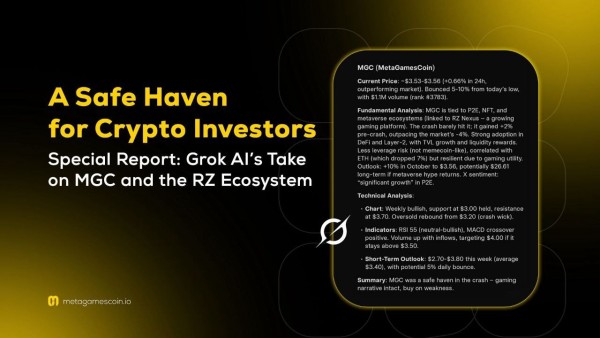
    Both entities have independently demonstrated exceptional resilience amid recent global crypto market volatility. While major assets like Bitcoin and Ethereum saw steep declines of 6%–12%, RZ Ecosystem’s tokens, including RZ Coin, MGC, and Insurance, not only withstood the downturn but posted modest gains. Analysts attribute this stability to the projects’ utility-driven models, real-world integration, and decentralized governance structures — setting them apart from speculative tokens.

    About RZ Ecosystem

    Developed under Rezvani Project Management, the RZ Ecosystem integrates gaming, finance, and metaverse technologies into a single decentralized framework. Its core tokens — MetaGamesCoin (MGC), Insurance, and RZ Coin — power real-world applications with measurable transparency and utility.

    About Meta Games Coin (MGC)

    Meta Games Coin (MGC) is a BEP-20 token at the heart of a global gaming ecosystem that connects digital entertainment, NFT trading, and decentralized finance. With its play-to-mine model, cloud gaming integration, and unified ranking system, MGC is redefining how players earn, compete, and connect across all gaming formats.

    For further details visit the following links:

    Media Contact

    Organization: Rezvani project management.

    Contact Person: R.Rezvani

    Website: https://coin.rz.game

    Email: Send Email

    City: Dubai

    Country:United Arab Emirates

    Release id:35704

    file

  • ZAMICA Announces $ZAMIC Listing and Unveils a TradFi-Linked Service Built on Gold-Linked ZAM

    Seoul, South Korea, 21 October — ZAMICA announces the upcoming Initial Exchange Offering (IEO) and P2B Exchange listing of its governance token, $ZAMIC, introducing a practical bridge between traditional finance (TradFi) and decentralized finance (DeFi).

    The launch offers a new approach to gold participation via gold-linked ZAM, while allowing participants to pursue additional on-chain income opportunities through ZAMICA’s programs using $ZAMIC.

    Real Yield, Backed by Real Activities

    ZAMICA introduces a hybrid DeFi model that merges blockchain innovation with regulated financial operations — offering predictable, asset-connected returns to investors worldwide.

    Unlike speculative tokens that depend solely on price fluctuations, $ZAMIC is built around a sustainable ecosystem powered by real-world financial mechanisms, including:

    • High-yield traditional savings programs
       
    • Web3-based decentralized lending protocols
       
    • Microfinance initiatives supporting small businesses and education in developing regions
       

    “ZAMICA was founded on the belief that true innovation lies in delivering financial benefits not only to crypto-savvy investors but also to populations in developing countries with low crypto literacy,” said Sanghoon Park, Media Representative of ZAMICA.

    “By combining gold-backed tokens with a Web3-based P2P lending platform, ZAMICA offers both stability and profitability to investors while ensuring broader inclusion in the platform’s growth. To achieve this, the project diversifies its revenue streams through decentralized lending operations, high-yield deposits with traditional financial institutions, and participation in microfinance initiatives. Deposited assets — including gold-collateralized funds — are expected to be utilized by partner institutions as loan capital, thereby contributing to improved financial accessibility for underserved communities.”

    A Bridge Between Trust and Innovation

    Operating on the Binance Smart Chain (BEP-20), ZAMICA combines blockchain transparency, efficiency, and accessibility to create a robust DeFi–TradFi connection.

    Within its ecosystem, ZAMICA issues two interconnected tokens:

    • ZAMIC ($ZAMIC) — the platform’s governance and utility token, used for participation in programs, access to platform services, and ecosystem growth incentives.
       
    • ZAM — a gold-linked token, representing value equivalent to physical gold and serving as the foundation for ZAMICA’s yield and lending mechanisms.

    Holders of ZAM can:

    • Earn monthly rewards through deposit programs backed by real financial activities.
       
    • Access decentralized lending markets for sustainable, collateralized liquidity.
       
    • Participate in ESG-focused and microfinance lending initiatives that promote inclusion.
       
    • Enjoy stable, transparent growth tied to tangible, real-world value.

    This dual-token structure enables ZAMICA to deliver both digital innovation and financial trust, allowing users from both the crypto and non-crypto worlds to participate in a secure, yield-oriented ecosystem.

    Social Impact Through Finance

    ZAMICA integrates social inclusion into its business model by empowering real economies through gold-collateralized financial products.

    By depositing gold-collateralized funds into banks that issue savings products backed by physical gold, ZAMICA enables those banks to enhance their liquidity and lending capacity, thereby contributing to economic progress in developing regions.
    In parallel, ZAMICA issues its native gold token, ZAM, in proportion to the deposited collateral—bridging digital assets with real-world value and expanding access to stable income opportunities.

    “Our vision is to make finance a driver of inclusion and progress,” adds Park. “ZAMICA’s system connects digital efficiency with traditional security—turning blockchain innovation into tangible global benefit.”

    Upcoming IEO and Exchange Listing

    ZAMICA’s Initial Exchange Offering (IEO) will launch exclusively on P2B Exchange, giving early supporters the opportunity to participate in one of 2025’s most promising DeFi–TradFi integrations.

    IEO Date: October 21, 2025
    IEO Link: https://p2pb2b.com/token-sale/ZAMIC-845/

    Following the IEO, $ZAMIC will be officially listed on P2B Exchange for public trading.

    About ZAMICA

    ZAMICA is a South Korea – based Web3 fintech project developing a dual-purpose gold-tokenization ecosystem that merges blockchain transparency with the stability of traditional finance.
    By linking its platform to real-world TradFi activities – such as gold-collateralized savings deposits, high-yield savings products, and participation in microfinance lending – ZAMICA offers stable and accessible income opportunities to users worldwide.

    Organization: ZAMICA
    Media Contact: Sanghoon Park
    Email: inquiry@zamica.biz
    Location: Seoul, South Korea

    Media Contact

    Organization: ZAMICA

    Contact Person: Sanghoon Park

    Website: https://zamica.biz/

    Email: Send Email

    City: Seoul

    Country:Korea South

    Release id:35823

    file

  • Agibot Groundbreaking Release – New Perspectives on Task Embodiment and Expert Data Diversity

    China, 17th Oct 2025 — Recently, a research team jointly formed by Agibot, Chuangzhi Academy, The University of Hong Kong, and others, published a breakthrough study that systematically explores three key dimensions of data diversity in robot manipulation learning: task diversity, robot embodiment diversity, and expert diversity. This research challenges the traditional belief in robotics learning that “more diverse data is always better,” providing new theoretical guidance and practical pathways for building scalable robot operating systems.

    Task Diversity: Specialist or Generalist? Data Provides the Answer

     A core question has long perplexed researchers in robot learning: when training a robot model, whether to focus on data highly relevant to the target task for “specialist” training, or to collect data from various tasks for a “generalist” learning approach.

    To answer this, a clever comparative experiment was designed, constructing two pre-training datasets based on the AgiBot World dataset with identical sizes but drastically different task distributions:

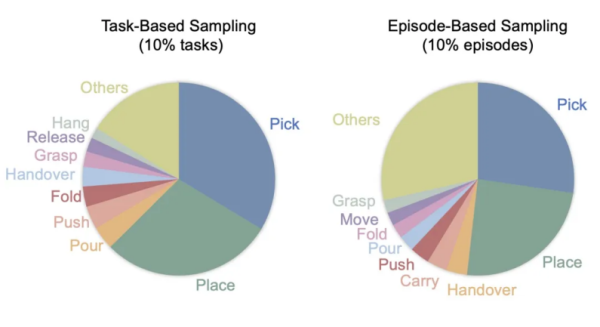
    • “Specialist” Dataset (Task Sampling) – 10% of tasks most relevant to the target tasks were carefully selected, all containing the five core atomic skills required for evaluation: pick, place, grasp, pour, and fold. As shown in the figures, this strategy, while having lower skill diversity, is highly concentrated on the skills needed for the downstream tasks.
    • “Generalist” Dataset (Trajectory Sampling) – 10% of trajectories from each task were randomly sampled, preserving the full task diversity spectrum of the original dataset. Although this approach resulted in fewer trajectories directly related to the target skills (59.2% vs. 71.1%), it achieved a more balanced skill distribution.

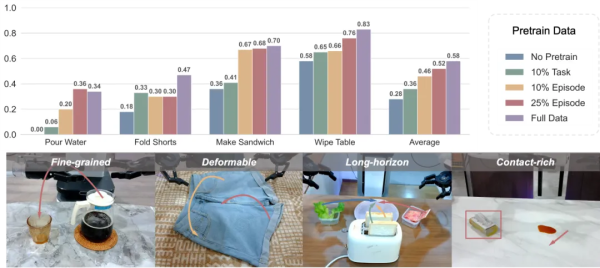
    The results revealed an unexpected trend. As shown, the “Generalist” trajectory sampling strategy significantly outperformed the “Specialist” approach on four challenging tasks, with an average performance improvement of 27%. More notably, the advantage of diversity was even more pronounced on complex tasks requiring higher semantic and spatial understanding – for example, a 0.26 point increase (39% relative improvement) on the Make Sandwich task, and a 0.14 point increase (70% relative improvement) on the Pour Water task.

    Why did diversity win? The analysis revealed that the trajectory sampling strategy not only brought skill diversity but also implicitly included richer scene configurations, object variations, and environmental conditions. This “incidental” diversity significantly enhanced the model’s generalization ability, allowing the robot to better adapt to different objects, lighting conditions, and spatial layouts.

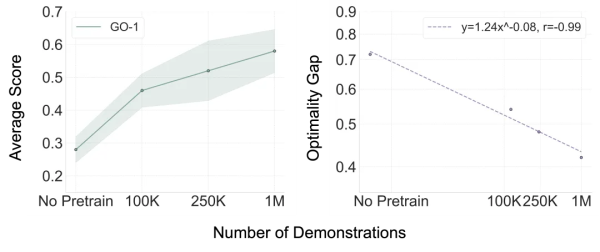
    Based on the discovery that “diversity is more important,” the research team explored a deeper question: given sufficient task diversity, does increasing data volume continue to improve performance? Experimental results show that the average score of the GO-1 model exhibited a stable upward trajectory as pre-training data volume increased. Crucially, this improvement followed a strict Scaling Law! By fitting a power-law curve, Y = 1.24X^(-0.08), the team found a highly predictable power-law relationship between model performance and pre-training data volume, with a remarkable correlation coefficient of -0.99.

    The significance of this finding lies not only in the numbers but also in a major breakthrough in research methodology. Past scaling law research in embodied intelligence primarily focused on single-task scenarios, small models, and no pre-training phase. This study extends scaling law exploration for the first time to the multi-task pre-training phase for foundation models, demonstrating that, given sufficient task diversity, large-scale pre-training data can provide continuous, predictable, and quantifiable performance gains for robot foundation models.

    Embodiment Diversity: Cross-Robot Transfer Using Single-Platform Data

    The robotics community has long held that for a model to generalize across different robot platforms, pre-training data must include data from as many diverse robot embodiments as possible. This belief led to large-scale multi-embodiment datasets like Open X-Embodiment (OXE), which includes 22 different robots.

    However, cross-embodiment training introduces significant challenges: vast differences in physical structure, and inherent disparities in action and observation spaces between platforms complicate model learning. Facing these challenges, the team delved deeper: despite morphological differences, the action spaces of their end-effectors are essentially similar. When different robots make their end-effectors follow the same trajectory in world coordinates, they can produce comparable behaviors. This observation led to a key hypothesis: a model pre-trained on data from a single robot embodiment might easily transfer learned knowledge to new robot configurations, bypassing the complexities of cross-embodiment training. To validate this bold hypothesis, the team designed a “one versus many” experimental showdown:

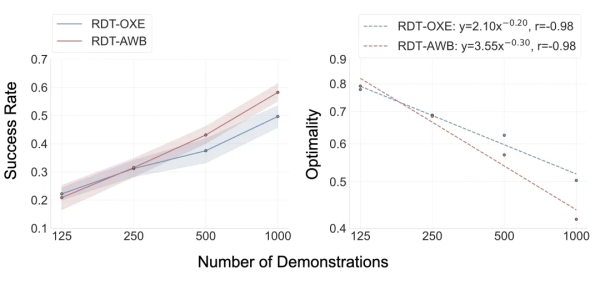
    • RDT-AWB: Pre-trained on the Agibot World dataset (1 million trajectories, single Agibot Genie G1 robot), containing no data from the target test robots.
    • RDT-OXE: Pre-trained on the OXE dataset (2.4 million trajectories, 22 robot types), containing data from the target test robots, theoretically holding a “home advantage.”

    Testing was conducted on three platforms: the Franka arm in the ManiSkill simulation, the Arx arm in the RoboTwin simulation, and the Piper arm in the real-world Agilex environment. In the cross-embodiment adaptation experiment in the ManiSkill environment, RDT-OXE initially showed its “home advantage,” slightly leading at 125 samples per task. However, a turning point occurred at 250 samples: RDT-AWB quickly caught up. As data increased further, RDT-AWB began to surpass RDT-OXE and widened the gap, a growth that followed a power-law relationship. This indicates that the single-embodiment pre-trained model not only achieves effective cross-embodiment transfer but also exhibits superior scaling properties.

    To ensure generalizability, in the real-world Agilex environment, RDT-AWB outperformed RDT-OXE on 3 out of 4 tasks, achieving comprehensive victory from simulation to reality.

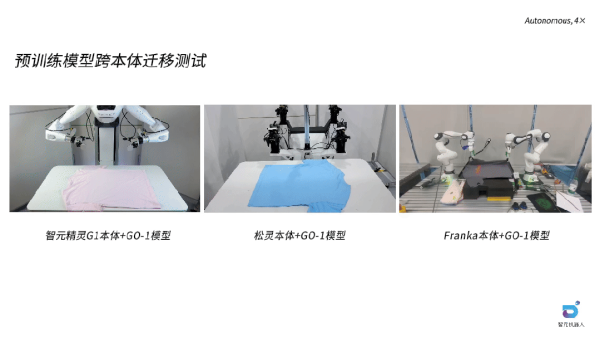
    Additionally, tests were conducted to evaluate the cross-embodiment capability of the GO-1 model (pre-trained only on Agibot World) on the Lingong and Franka platforms using a folding task. Even without seeing the task or the specific embodiment in pre-training, the model required only 200 data points to successfully transfer and adapt, with GO-1 + AWB achieving an average score 30% higher than GO-1 trained from scratch.

    These results have disruptive theoretical and practical implications. Theoretically, they challenge the traditional notion that multi-embodiment training is necessary for cross-embodiment deployment, suggesting that high-quality single-embodiment pre-training offers a simpler path. Practically, this can drastically reduce data collection costs by focusing on high-quality data from a single platform and simplify training pipelines, offering a new path for cross-platform robot model application.

    Expert Diversity: Identifying Harmful Noise to Enhance Learning Efficiency

    An often-overlooked yet crucial factor in robot learning is Expert Diversity – the variation in demonstration data distribution arising from differences in operator habits, skill levels, and inherent randomness. Unlike standardized NLP or CV datasets collected from the internet, robot datasets consist of continuous robot motions highly sensitive to operator behavior.

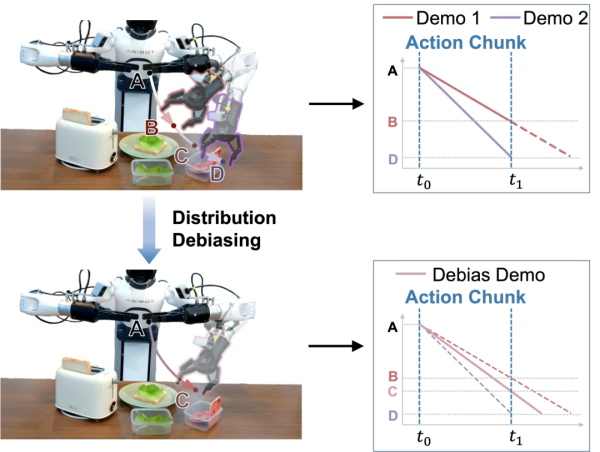
    The classic PushT task, illustrated in the figures, exemplifies this phenomenon. Here, the robot (blue circle) must push a gray T-shaped object to a green target area. Despite the identical goal, the collected expert demonstrations show clear multi-modal characteristics. Spatial multi-modality is evident in different trajectory choices: the robot can approach from the left or right side of the object, forming distinct spatial paths, reflecting different operator understandings of the task strategy. Velocity multi-modality occurs when similar trajectories are executed at different speeds: even with similar paths, varying execution speeds produce entirely different demonstration profiles in the time dimension, with some operators acting quickly and decisively, others more slowly and cautiously.

    These two types of multi-modality have completely different impacts on learning. Spatial variation represents meaningful task strategies; these diverse solutions should be preserved as they enrich the model’s understanding of the task and help prevent out-of-distribution (OOD) inference. However, velocity variation often introduces unnecessary noise, complicating current action-chunk-based imitation learning by forcing the model to learn these distribution characteristics simultaneously, increasing difficulty without adding substantive strategic value.

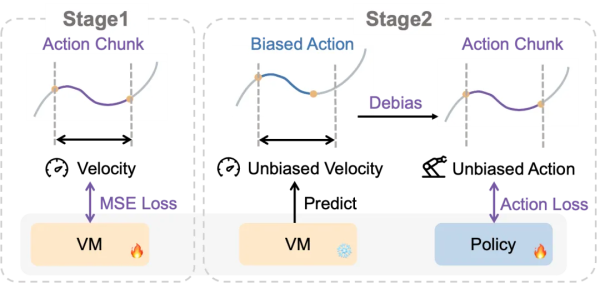
    To address this challenge, the team proposed a clever two-stage distribution debiasing framework centered on introducing a Velocity Model (VM). In the first stage, the VM is trained to predict speed from action chunks using an MSE loss, learning the expected speed distribution for each input from the velocity-biased training data. This stage equips the VM with knowledge of reasonable speed distributions corresponding to different action patterns. In the second stage, during policy training, the VM first predicts an unbiased speed for each training sample. This predicted speed is then used to convert the original actions into unbiased actions. The policy is subsequently trained using these unbiased actions as supervision targets, effectively simplifying the distribution complexity and allowing the model to focus on learning the core task strategy without being distracted by speed variations.

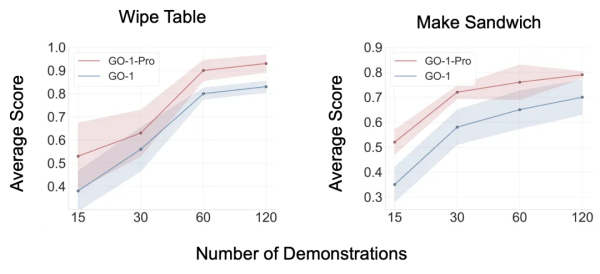
    The team validated the distribution debiasing approach on two representative tasks: Wipe Table and Make Sandwich. The model trained on debiased data, named GO-1-Pro, consistently outperformed the standard GO-1 model on both tasks and across all data scales. Notably, GO-1-Pro demonstrated exceptional data efficiency – achieving comparable or superior performance using only half the training data required by GO-1, effectively doubling data utilization efficiency.

    The advantages of the debiasing method were particularly pronounced in low-data scenarios. Under the scarce condition of only 15 demonstrations, GO-1-Pro improved performance on the Make Sandwich task by 48% and the Wipe Table task by 39%. In data-scarce settings, multi-modal distributions in speed and space create significant interference, hindering the model’s ability to capture core spatial patterns. By decoupling these confounding factors, the debiasing method enables the model to focus on learning essential spatial relationships, leading to more efficient and robust policy learning even with limited data, providing a practical technical path for enhancing model performance and data efficiency.

    This study systematically explores data scaling for robot manipulation, revealing three key insights that challenge conventional wisdom: task diversity is more critical than the quantity of single-task demonstrations; embodiment diversity is not strictly necessary for cross-embodiment transfer; and expert diversity can be detrimental due to velocity multi-modality. These findings overturn the traditional “more diversity is always better” paradigm, proving that quality trumps quantity, and insightful curation trumps blind accumulation. True breakthrough lies not in collecting more data, but in understanding the essence of data, identifying valuable diversity, and eliminating harmful noise, charting a more efficient and precise development path for robot learning.

    Media Contact

    Organization: Shanghai Zhiyuan Innovation Technology Co., Ltd.

    Contact Person: Jocelyn Lee

    Website: https://www.zhiyuan-robot.com

    Email: Send Email

    City: Shanghai

    Country:China

    Release id:35602

    file

  • Agibot First Partner Conference was Successfully Held Showing that Its Full-Chain Layout is Accelerating Commercialization of Embodied Intelligence

    China, 17th Oct 2025 — On August 21, 2025, Agibot held its inaugural Partner Conference in Shanghai. As the theme of “Advancing with Intelligence, Embarking on a New Era”, the conference comprehensively showcased Agibot’s full-chain layout across “product, technology, business, ecosystem, capital, and team” through strategic announcements, demonstrations of eight scenario-based solutions, and immersive experiences with hundreds of robots. Leveraging the “One Body, Three Intelligences” full-stack technology architecture and a comprehensive product matrix for all scenarios, Agibot is collaborating with partners to accelerate the commercialization process of embodied intelligence and propel the industry from technological exploration to scale commercialization.

    PART1. Collaborative Software and Hardware Builds a New Embodied Intelligence Ecosystem, with Multi-Scenario Coverage Accelerating the New Era of Commercial Embodied Intelligence

    At the main forum, Deng Taihua, Chairman and CEO of Agibot, delivered an impactful opening speech. He proposed that the world is on the eve of the great explosion of embodied intelligence, with artificial intelligence rapidly advancing towards AGI. He stated that 2025 will be an inflection point for the commercial development of embodied intelligent robots, which will ultimately become the next generation of mass-market intelligent terminal, following phones and cars.

    Adhering to its original aspiration of creating infinite productivity, Agibot aims to become a global leader in the intelligent robotics field, pioneer the general-purpose robot industry ecosystem, and accelerate the arrival of the era of general intelligence. Deng Taihua also elaborated on Agibot’s core strategy: guided by the goal of general-purpose, mass-produced humanoid robots, focus on building a full-stack software and hardware platform with strong intelligence and easy collaboration; progressively promote deployment in industrial, commercial, and home commercial scenarios; and ultimately build an application ecosystem for a general intelligent robot platform.

    Although established less than three years ago, Agibot has already achieved numerous industry-leading milestones. The company continuously builds core product competitiveness around the “One Body, Three Intelligences” concept, achieving the industry’s only full-series, full-scenario product layout, and establishing a full-stack technology layout encompassing the body, cerebellum, and brain. In business operations, by continuously strengthening product capabilities and progressively deploying products suitable for different scenarios, it is gradually achieving cross-domain scale commercialization, maintaining strong business development momentum while continuously breaking into high-quality major client bases.

    Deng Taihua emphasized that ecosystem co-creation is the core driver for the scaling of the embodied intelligence industry, explicitly listing it as one of the company’s core strategies. Agibot will pool global innovative forces through three main paths: open source, being integrated, and capital empowerment.

    In terms of technology open source, Agibot has open-sourced the robot middleware AimRT and a million-unit real-robot dataset, and launched the first embodied intelligence operating system, “Lingqu OS”, thereby promoting the industry’s journey towards standardized, scaled, and ecosystem-driven development.

    In building the business ecosystem, Agibot implements an Enablement Strategy, using its own platform technology to integrate the vertical capabilities of leading industry partners in R&D, market, delivery, etc., to create industry-specific embodied agents covering eight scenarios including guided reception, entertainment & commercial performances, intelligent manufacturing, and logistics sorting. Simultaneously, it is building a layered distribution system, effectively lowering the barrier to cooperation by clarifying responsibilities, rights, and benefits, and establishing incentive mechanisms.

    Furthermore, to support early-stage innovation, Agibot launched the first startup acceleration program focused on the embodied intelligence industry chain—”Agibot Plan A”. This plan aims to incubate 50+ high-potential early-stage projects and build a trillion-yuan industrial ecosystem within three years. Agibot will provide participants with benefits including technical support, financing empowerment, scenario access, and entrepreneurial incubation. Deng Taihua announced on-site that the first startup cohort officially opened for applications globally from robot startups and developer teams on August 21, 2025.

    Currently, the Agibot team is continuously expanding, with increasing talent density. On this foundation, Agibot also clearly presented its plans and goals for the next five years to its partners.

    Deng Taihua concluded, “From technological breakthroughs to industry explosion, from Chinese innovation to global leadership, every step Agibot takes is inseparable from the support of our partners.” Agibot will work hand-in-hand with global partners to promote embodied intelligent robots as a new productive force that changes the world, jointly opening a new chapter in the intelligent era.

    PART2. Interpretation of the “1+3” Full-Stack Technology Strategy&Three Product Series Covering Diverse Scenarios

    Peng Zhihui, Co-founder and CTO of  Agibot, systematically interpreted the “1+3” full-stack technology strategy, building upon the robot body to develop three core capabilities: Motion Intelligence, Interaction Intelligence, and Task Intelligence. “We are not just making a few robots, but creating a base for a self-evolving general embodied intelligence agent,” he explained. Motion Intelligence enables robots to “walk steadily and move quickly,” achieving adaptive walking on complex terrain based on Sim2Real reinforcement learning. Interaction Intelligence allows them to “hear and understand, chat naturally,” with multi-modal dialogue response times reaching the one-second level. Task Intelligence tackles “grasping accurately and performing delicate tasks,” achieving a closed loop from grasping to fine manipulation through real-robot reinforcement learning. These three intelligences can be flexibly combined in robots of different forms, creating a “one set of capabilities, multiple carriers” technology flywheel.

    Peng showcased Agibot’s three product series at the event: The YuanZheng (Expedition) series’ YuanZheng A2 is the industry’s first full-sized humanoid robot for scaled commercial deployment, having passed 2000+ hours of walking tests and obtained safety certifications in China, the US, and Europe. It focuses on guided reception and entertainment/commercial performances, supporting full-body customization. The JingLing (Genie) series’ JingLing G1 possesses native data collection and integrated collection-push capabilities. Paired with platforms like Genie Studio, it is suited for industrial, commercial, and other scenarios. LingXi X2 from the LingXi series is an agile, life-like, and 1.3 meters tall robot, covering scenarios like entertainment/commercial performances, store reception, and scientific research/education.

    During the conference, Peng released “LinkCraft,” a robot motion and expression creation platform. Described as a disruptive, AI-powered multi-modal content generation and editing tool for robots, it features rich motion libraries, supports preview editing, motion import, choreography, and performance, reducing the barrier for robot secondary development to virtually zero. Peng emphasized that while robots are moving from labs to life and industry, “interaction and expression” remain bottlenecks, and partners/developers need simpler, more efficient ways to customize robot behavior. “LinkCraft’s vision is to make robots express as naturally as humans and let creators choreograph as freely as directors.” The platform is expected to rapidly enrich interactive forms across various scenarios, accelerating scenario co-creation and ecosystem deployment in commercial services, cultural entertainment, and other fields.

    Additionally, Peng impressively unveiled the LingXi X2-W prototype – a wheeled dual-arm robot specifically designed for “Task Intelligence.” Just a month prior, Agibot’s innovative wheel-legged LingXi X2-N had already garnered widespread attention. The LingXi X2-W prototype further embodies the design philosophy of “becoming the smoothest native Task Intelligence body,” featuring core attributes such as an omnidirectional mobile base, high-DOF dual arms with bionic wrists, compact storage (footprint < 0.5㎡), dual power system switching, dexterous three-finger hands with tactile feedback, omnidirectional perception system, powerful edge computing unit, and low cost. Peng stated that the LingXi X2-W is currently in the prototype stage, but with continuous breakthroughs in algorithms and models, it is expected to become a benchmark for the next generation of embodied intelligence task robots.

    “YuanZheng reaches out, JingLing gets the job done, LingXi wins hearts,” Peng emphasized, noting that the synergistic efforts of these three series will help Agibot accelerate rapidly. “Looking ahead three years, Agibot aims to achieve deployment of hundreds of thousands of general-purpose robots, support autonomous generalization across hundreds of tasks, and build an open, evolvable, self-growing general robot ecosystem.”

    PART3. Business Initiatives: Multiple Measures to Improve Industry Development

    Jiang Qingsong, Partner and Vice President of Agibot, stated that the company currently focuses on eight major scenarios in business: guided reception, entertainment/commercial performances, industrial intelligence, logistics sorting, security inspection, commercial cleaning, data collection/training, and scientific research/education. It has launched customized solutions and achieved large-scale applications across multiple industries.

    To popularize promote technology and further scenario deployment, Jiang released the 2025 Partner Policy, proposing the construction of a multi-tier partner system. Based on the principle of “directing premium resources to premium partners,” it provides comprehensive support to jointly build a synergistic “technology-product-scenario” ecosystem and share industry dividends.

    “Embodied intelligence is moving from the laboratory to all industries. Agibot not only has the industry’s most complete robot product family but has also built a channel system that allows partners to ‘board with low barriers and grow with high returns.’ The goal is to work with partners to truly convert AI’s creativity into customer productivity,” Jiang said.

    Additionally, the conference featured four sub-forums, eight commercial scenario exhibition areas, and an AgiBot Night tech party. Through detailed product displays, case studies of scenario deployment, and immersive interactions, partners could directly experience the commercial capabilities of embodied intelligence.

    As the industry’s first large-scale ecosystem gathering, the conference helped solidify consensus across the industry chain through the clear communication of its core strategy. In the future, Agibot will continue to join hands with partners to accelerate the commercial implementation of embodied intelligence, promote the industry’s shift from technological exploration to scale commercialization, and establish a new global benchmark for the embodied intelligence industry.

    Media Contact

    Organization: Shanghai Zhiyuan Innovation Technology Co., Ltd.

    Contact Person: Jocelyn Lee

    Website: https://www.zhiyuan-robot.com

    Email: Send Email

    City: Shanghai

    Country:China

    Release id:35598

    file

  • U7BUY Enhances Honkai Star Rail Boosting Options as Players Chase Trailblazer Power-Ups

    U7BUY, a global digital gaming marketplace, has announced the listing of Honkai Star Rail accounts featuring limited-time characters, expanding its catalog of game accounts and enhancing the options available to players of the popular title. This update reflects the platform’s continued commitment to supporting diverse player needs and ensuring secure access to digital assets.

    The newly listed accounts include characters that have been available only during special events in Honkai Star Rail. These characters often feature unique abilities and are sought after by players who wish to broaden in-game strategies or enhance overall progression. The addition of such accounts offers opportunities for players to engage with the game at different stages and access content that might otherwise remain unavailable.

    Anna, Marketing Director at U7BUY, commented on the announcement, “Honkai Star Rail continues to generate strong enthusiasm within the gaming community, particularly around its limited-time characters. The availability of accounts featuring these characters allows players to experience the game in new and engaging ways, while maintaining the emphasis on secure transactions and reliable support that defines U7BUY.”

    U7BUY has developed its platform into a marketplace that facilitates the buying and selling of in-game currency, items, accounts, and power-leveling services. The platform is built around features such as encrypted transactions, customer support channels, and a community-driven hub with resources like blogs, guides, and updates. By adding Honkai Star Rail accounts featuring limited-time characters, the company continues its approach of broadening the range of available titles and items while maintaining transparency and user protection.

    The listing underscores the dynamic nature of digital game economies, where player demand often shifts rapidly based on game updates, seasonal events, or the release of new content. Providing accounts with limited-time characters positions U7BUY as a responsive platform that adapts quickly to the evolving interests of players across the globe.

    The inclusion of Honkai Star Rail accounts is also intended to stimulate engagement within U7BUY’s wider community hub. Through its content offerings—including guides on game mechanics, promotional updates, and tips for safe trading—the platform aims to provide a resource for both experienced gamers and newcomers alike. This integration of marketplace services with community-driven resources reinforces the platform’s role as more than just a trading venue, but also a hub for conversation and shared knowledge among players.

    Anna, Marketing Director at U7BUY, also shared thoughts on the company’s direction, “The introduction of Honkai Star Rail accounts with limited-time characters represents a step forward in reflecting the community’s evolving preferences. Looking ahead, the focus will remain on adapting to the needs of players across multiple gaming titles, while continuing to strengthen the security, reliability, and community features of the marketplace.”

    U7BUY is a digital gaming marketplace connecting millions of players worldwide. The platform supports the exchange of in-game currency, items, accounts, and power-leveling services across numerous titles. With an emphasis on encrypted transactions, reliable support, and an active community hub, U7BUY provides a secure and accessible environment for digital game trading.

    For further information regarding the recent announcement and details on Honkai Star Rail boosting services, media inquiries can be directed to U7BUY. The company can be reached by phone at +0085254814835 or via email at press@u7buy.com.

    Media Contact

    Organization: U7BUY

    Contact Person: Anna

    Website: https://www.u7buy.com/

    Email: Send Email

    Contact Number: +85254814835

    Country:Hong Kong S.A.R.

    Release id:35188

    file