Blog

  • GDC’s Dual Trend: AI-Native Gaming Meets Protocolization Enter Web3 Game Tatakai

    Hong kong, March 23rd, 2026, ZEX PR WIREEach year, the Game Developers Conference (GDC) highlights the ideas shaping the next phase of the gaming industry. While past conversations often focused on graphics engines or platform expansion, recent discussions have pointed to bigger structural changes in game design.
    The trend is becoming increasingly clear: the rise of AI-native game worlds and the growing protocolization of game systems.
    Games are evolving from static entertainment products into intelligent, persistent environments. At the same time, developers are beginning to separate the underlying mechanics of a game from the game itself, transforming them into reusable systems that can support broader ecosystems.
    Tatakai sits at the intersection of these movements.


    AI-Native Games: Worlds Shaped by Intelligent Systems
    One of the most widely discussed topics at GDC has been the increasing role of AI in game development. Rather than manually scripting every character behavior or gameplay outcome, developers are building AI-driven systems that allow worlds to evolve dynamically.

    AI-powered NPCs, procedural environments, and adaptive narrative systems enable games to react to player behavior in real time. Instead of following fixed storylines or predetermined sequences, players interact with systems that continuously generate new possibilities.
    This shift marks the emergence of AI-native games—experiences where intelligent systems are embedded directly into the core gameplay.
    Now, gameplay becomes more emergent. Player decisions influence the state of the world, while AI-driven systems adapt and respond to those actions. The result is a more organic form of interaction, where the game world behaves less like a scripted system and more like a living world.
    Tatakai reflects this design philosophy by emphasizing interaction, strategy, and evolving environments. Rather than guiding players through fixed structures, the game encourages players to explore and influence a dynamic ecosystem shaped by both player behavior and system-level logic.


    The Protocolization of Games
    Alongside the rise of AI-driven worlds, another important shift is taking place: games are increasingly being designed as systems rather than standalone products.

    In traditional game development, mechanics, economies, and interactions are tightly bound to a single title. But as games grow more complex and interconnected, developers are beginning to separate these mechanics into reusable frameworks.

    This process, sometimes described as the protocolization of games, turns core gameplay systems into foundational infrastructure.
    The idea is similar to how internet protocols enabled entire ecosystems of services. By abstracting core mechanics into protocols, developers can create things where new games, tools, or experiences build on shared foundations.
    This approach is increasingly relevant in open and decentralized contexts, where interoperability and extensibility are essential.


    Tatakai: A Game Built on a Protocol
    Tatakai reflects both of these emerging trends through a dual-layer design: a playable game experience supported by Tatakai Protocol.

    Tatakai Protocol represents the underlying framework that powers coordination, gameplay logic, and ecosystem interaction. Rather than being limited to a single game, the protocol provides a structure that can support future extensions and new experiences built on the same principles.
    In this model, the game becomes the entry point, while the protocol represents the long-term infrastructure.
    As the gaming industry moves toward AI-native systems and protocol-based design, projects that combine both layers may define the next generation of interactive worlds. Tatakai is not only building a game within that future. It is building part of the framework that could support it.
  • Otonomii AI Acquires AI Signals to Expand Enterprise Platform for Autonomous Market Intelligence 

    New York, NY, March 23rd, 2026, Otonomii AI, a financial technology company building native artificial intelligence for autonomous trading and market risk analysis, today announced the acquisition of AI Signals (aissignals.com), a retail AI trading signals platform. The acquisition marks a defining step in Otonomii AI’s mission to create continuously learning investment systems that adapt to markets in real time.

    The acquisition allows Otonomii AI to extend its proprietary cognitive architecture — a One Brain, Multiple Minds system where a single domain-agnostic memory infrastructure powers specialized, continuously learning market intelligences — beyond internal capital deployment into a broader ecosystem serving retail traders, institutional desks, and brokerage platforms worldwide.

    Otonomii AI develops proprietary trading intelligence systems designed to perceive financial markets, learn from their structure, and deploy capital using continuously evolving AI architectures. The company’s technology was originally built for internal trading and risk-management applications, where the system operates using the firm’s own capital. Unlike conventional AI trading tools that rely on static models and historical pattern matching, Otonomii’s systems are designed to recognize when market conditions have fundamentally changed — and adapt autonomously.

    Through the acquisition of AI Signals, Otonomii will extend this technology into an enterprise-grade platform that serves the full spectrum of market participants — from individual traders seeking intelligent signals to brokers requiring embedded AI infrastructure for their clients.

    AI Signals currently operates a trading signals terminal designed for beginner, intermediate, and advanced traders, offering structured signal generation, market state analysis, and risk-management tools. The platform will serve as the retail and broker distribution layer for Otonomii AI’s continuously learning technology.

    Following the acquisition, Otonomii AI plans to expand the platform’s capabilities and accelerate its enterprise roadmap, including:

    •         Expansion into equities, futures, and additional financial markets
    •         Seamless integration with MT4 and MT5 trading platforms
    •         Broker-level API connectivity for embedded AI market intelligence
    •         Dedicated mobile and desktop applications
    •         Autonomous strategy modules that learn and adapt without manual recalibration

    This infrastructure will allow brokers to offer AI-driven market intelligence directly to their clients, while Otonomii AI builds toward its long-term vision: fully autonomous investment systems governed by transparent, auditable frameworks.

    Founder Statement

    Kaushal Sheth, creator of Otonomii AI, commented:

    “The financial industry is entering the autonomy era. Traditional trading tools — even those branded as AI — are still fundamentally static systems that break when markets shift. Otonomii AI was designed from first principles as a system that doesn’t just analyze markets but learns them continuously, the way an experienced trader builds intuition over decades — except the machine never stops learning and never forgets. With the acquisition of AI Signals, we can now deliver this intelligence not only to our internal trading infrastructure, but to brokers and traders worldwide. This is the beginning of something much larger.”

    Market Opportunity

    The global financial AI market is undergoing a structural transformation. According to industry research, 44% of enterprise finance teams plan to deploy agentic AI systems in 2026 — a 600% increase year-over-year. The World Economic Forum has declared that banking is entering the “agentic era,” transitioning from AI assistance to transactional authority. Meanwhile, S&P Global’s $1.8 billion acquisition of With Intelligence in late 2025 signals massive institutional appetite for specialized AI-powered financial data platforms.

    By combining Otonomii AI’s proprietary cognitive architecture with AI Signals’ existing retail infrastructure and user community, the platform aims to create a new category of continuously learning broker intelligence tools. Brokers will be able to offer advanced, adaptive market analysis capabilities directly to their users — while traders gain access to autonomous AI systems previously limited to institutional environments.

    About Otonomii AI

    Otonomii AI is a native artificial intelligence company focused on financial markets, specializing in autonomous trading intelligence and risk-management systems.

    Unlike traditional signal platforms that rely on static algorithmic models or historical pattern recognition, Otonomii AI is built on a cognitive architecture inspired by how the human brain organizes intelligence: one universal memory system — the Brain — that stores, links, and consolidates experience, with multiple specialized Minds that each learn a different domain. A Mind built for financial markets learns differently than a Mind built for equity futures, yet both draw from the same foundational memory infrastructure. This One Brain, Multiple Minds design allows the system to perceive market structure, recognize regime shifts, and evolve its strategies autonomously — compounding intelligence the way the best funds compound capital.

    The technology was developed by Kaushal Sheth, a fintech technology veteran and current Chief Technology Officer of GFT Technologies USA, a publicly traded global engineering firm specializing in enterprise technology solutions for financial institutions.

    About AI Signals

    AI Signals (aissignals.com) is a retail trading intelligence platform offering a full trading console designed for beginner, intermediate, and advanced traders.

    The platform provides AI-generated trade signals, market structure analysis, risk-management tools, and performance tracking. AI Signals is powered by Otonomii AI’s cognitive architecture, enabling traders to access market intelligence derived from continuously learning AI systems rather than static algorithmic models.

    AI Signals will continue operating under its existing brand as the retail distribution layer for Otonomii AI technology. 

    Media & Partnerships:
    Otonomii AI
    Email: press@otonomii.ai
    Website: www.otonomii.ai

    This press release has been done by GOLDENGATEPR

  • Budapest Interfaith Dialogue Highlights Ethics, Faith and Social Media

    Discussion hosted at the Church of Scientology in Budapest explored online hate, moral responsibility and how faith communities can regain credibility through conduct, with themes that echo principles found in The Way to Happiness

    Brussels, Belgium, 20th Mar 2026 — In a period marked by online hostility, polarized debate and growing concern over the social effects of digital communication, a March 11 interfaith roundtable hosted at the Church of Scientology Budapest examined whether people of faith can be expected to uphold a higher moral standard in the digital sphere and how religion can once again become meaningful, credible and even attractive in the 21st century.

    Held as the 11th Interfaith Dialogue under the title A Vision in an Age of Hate: How Can We Make Faith Cool Again?, the event brought together theologians, clergy, church leaders and religious thinkers for a discussion that moved beyond formal doctrine and focused on something more immediate: conduct. In particular, participants considered how believers respond to anger, provocation and division in an environment where social media algorithms often amplify extremes rather than reflection.

    One of the opening references was to a recent online initiative by a Catholic professor who called on believers to stand against hate speech and offer a better example in public discourse. That reference set the tone for the evening’s central question: whether faith should be visible not only in ritual or identity, but in the way people communicate, disagree and exercise restraint in difficult public conversations.

    Participants agreed that social media has created moral pressures and behavioral temptations that previous generations did not have to navigate in the same way. One Catholic theologian noted that modern societies do not always share a common moral foundation, even though freedom of expression remains a fundamental value. In that context, he used the image of “gardening” to describe personal responsibility online: individuals should moderate their own digital space, remove what is destructive and refuse to cultivate environments where contempt and aggression flourish unchecked.

    A religious scholar and philosopher added that the architecture of social media often works against consensus, since algorithms tend to reward emotional intensity and reinforce echo chambers. In such an environment, he suggested, religion could still play a constructive role as a moral community capable of countering radicalization, reducing hostility and encouraging a more human response to disagreement.

    The Scientology minister participating in the discussion reportedly stressed that not all hatred should be understood as proof of an inherently bad person. In many cases, he suggested, bitterness, disappointment and accumulated painful experiences are what speak through hostile behavior. From that perspective, he argued, spiritual understanding should help people rise above immediate reaction and take responsibility for the tone and consequences of their actions, especially in digital environments where harmful language can spread rapidly and widely.

    While the Budapest event was not specifically centered on The Way to Happiness, the concepts discussed during the evening closely reflect several of the ethical principles set out in that text, written by Scientology founder L. Ron Hubbard. Described on its official website as a nonreligious moral code made up of 21 precepts for better living, The Way to Happiness includes such principles as “Set a Good Example,” “Seek To Live With The Truth,” and “Respect the Religious Beliefs of Others.” These ideas resonate clearly with the concerns raised in Budapest: truthfulness in public speech, restraint in conflict, and respect across religious and ideological lines.

    This distinction is important. The significance of the Budapest dialogue lies not in presenting The Way to Happiness as the formal theme of the event, but in showing how the ethical concerns voiced by participants can be understood through a framework long promoted by Scientology in its moral and social outreach. In that sense, the discussion illustrated a broader interfaith reality in Europe today: communities with different beliefs can still find common ground in practical ethics, peaceful coexistence and the importance of example.

    The second major theme of the evening concerned the changing role of religion in contemporary society. Participants reportedly observed that although formal religiosity has declined in parts of Western Europe, individual spiritual searching remains strong. The issue, then, is not simply whether religion can become fashionable again, but whether it can show itself to be morally serious, socially useful and capable of speaking in language people recognize as authentic.

    One theologian reportedly argued that religious communities must learn to communicate differently depending on the audience, using forms of language that can reach both intellectual circles and ordinary readers. Another participant emphasized common ground, universal love and practical cooperation among churches, rather than mutual condemnation. The Scientology contribution to the discussion reportedly aligned with that view, stressing that the most persuasive witness religion can offer today is not argument alone, but visible action: demonstrating that people of different faiths are capable of working together in peace while respecting one another.

    That emphasis also corresponds with how the Church of Scientology Budapest presents itself locally: not only as a place where Scientologists gather for worship and religious services, but as a community space intended to foster dialogue and cooperation. Situated at Váci út 169 in Budapest, the church has served as a venue for events and encounters involving broader civic and interfaith participation.

    Ivan Arjona, representative of the Church of Scientology to the EU, OSCE, Council of Europe and UN, said: “The Budapest dialogue reflects a challenge facing all European societies: how to preserve dignity, truth and mutual respect in spaces that often reward the opposite. What emerged from the discussion is that ethical conduct still matters deeply. When people choose responsibility over reaction, and respect over contempt, they strengthen not only their own communities but the civic culture on which peaceful coexistence depends.”

    What emerged from the March 11 roundtable was a message extending well beyond one denomination. If faith is to regain credibility in a digital age, participants suggested, it will do so not through slogans or confrontation, but through conduct: through honesty, self-restraint, respectful dialogue and what several speakers described, in different ways, as love expressed in action. In that respect, the Budapest event offered a practical reminder that religion remains socially relevant when it helps people live together more decently, even amid disagreement.

    The Church of Scientology, its churches, missions, groups and members are present across Europe with a continent-wide presence through more than 140 churches, missions and affiliated groups in at least 27 European nations, alongside thousands of community-based social betterment and reform initiatives focused on education, prevention and neighbourhood-level support, inspired by the work of Scientology founder L. Ron Hubbard.

    Within Europe’s diverse national frameworks for religion, the Church’s recognitions continue to expand, with administrative and judicial authorities in Spain, Portugal, Sweden, the Netherlands, Italy, Germany Slovakia and others, as well as the European Court of Human Rights, having addressed and acknowledged Scientology communities as protected by the national and international provisions of Freedom of Religion or belief.

    Media Contact

    Organization: European Office Church of Scientology for Public Affairs and Human Rights

    Contact Person: Ivan Arjona

    Website: https://www.scientologyeurope.org

    Email: Send Email

    Address:Boulevard de Waterloo 103

    City: Brussels

    State: Brussels

    Country:Belgium

    Release id:42829

    file

  • Blockchain Investors Helping Shape Web3 Startups

    Blockchain investors are pouring fresh capital into Web3 startups as decentralized finance, tokenized assets, and on-chain applications move from experiments to real businesses. With global blockchain funding crossing $25 billion in recent years, founders are now competing not just for users, but for experienced backers who understand both crypto markets and startup growth.

    Blockchain investors are individuals or firms that fund blockchain-based ventures while also offering strategic guidance, technical insight, and access to industry networks. Today, figures like Naval Ravikant, Evan Luthra, or Balaji Srinivasan are part of a growing group of blockchain angel investors and top crypto experts helping early-stage teams refine products, tokenomics, and go-to-market plans.

    In this post, we’ll cover what blockchain investors actually do, how they help Web3 startups scale, the different types of crypto backers, and what founders can do to attract the right investors in a fast-moving Web3 landscape.

    Key Takeaways

    • Blockchain investors provide funding, mentorship, network access, and credibility.
    • Web3 startups depend on investor expertise, not just capital.
    • Types include angel investors, crypto VCs, and strategic investors.
    • Founders attract backers through strong whitepapers, working MVPs, and transparent tokenomics.

    What Are Blockchain Investors?

    Blockchain investors are individuals or firms that fund blockchain-based projects and Web3 startups, offering not only capital but also mentorship, industry access, and strategic guidance to help early-stage companies scale.

    Unlike traditional VCs, blockchain investors often hold domain-specific knowledge, including about smart contract architecture, token economics, and decentralized governance. Traditional VCs merely evaluate revenue models and market size. Blockchain investors evaluate protocol design, token utility, and on-chain activity alongside those metrics.
    Source | Top 30 VC firms investing in blockchain

    Their role in product validation is equally important. An experienced blockchain investor can identify flaws in a tokenomics model before launch, connect a team to auditors, or flag regulatory exposure early. All of which directly affect a startup’s market entry.

    How Blockchain Investors Support Web3 Startups

    Blockchain investors do far more than provide capital. Research from industry reports by CB Insights and PitchBook shows that well-connected crypto investors significantly increase the probability of follow-on funding and shorten product launch cycles for early-stage Web3 startups. Below is how that support typically works.

    1. Early-Stage Funding

    Early capital remains the foundation of Web3 innovation.

    • Seed and pre-seed capital: Seed and pre-seed capital to build core infrastructure.
    • Token investments: Many Web3 startups raise capital through token allocations alongside equity, creating hybrid funding structures.
    • Infrastructure grants: Ecosystem players such as the Ethereum Foundation and Polygon regularly distribute development grants to accelerate ecosystem growth.

    Early funding allows Web3 startups to build MVPs, conduct audits, and launch testnets before generating revenue.

    2. Strategic Mentorship

    Capital without expertise rarely succeeds in crypto markets.

    • Tokenomics design: Investors with blockchain experience help founders structure supply models, vesting schedules, and incentive systems.
    • Go-to-market planning: Top crypto experts such as Evan Luthra, Balaji Srinivasan, or Cynthia Wu often guide projects on community-led growth and narrative positioning.
    • Regulatory navigation: With tightening global scrutiny, investors advise startups on compliance frameworks across the U.S., EU, Dubai, and Singapore.

    PitchBook research shows that startups backed by sector-specialist investors tend to close larger Series A rounds than those backed by generalist funds.

    3. Network Access

    In Web3, distribution is often more valuable than development.

    • Exchange listings: Investor networks help projects approach centralized and decentralized exchanges for token listings.
    • Developer communities: According to the Electric Capital 2023 Developer Report, over 23,000 monthly active developers contribute to crypto projects, and investor-backed ecosystems attract a higher share of that talent.
    • Protocol partnerships: Strategic investors facilitate integrations with Layer-1 and Layer-2 ecosystems, increasing visibility and liquidity.

    This network effect accelerates adoption in ways that organic growth alone cannot.

    4. Credibility Boost

    Reputation plays a critical role in Web3 markets.

    • Investor reputation builds user trust: Association with recognized blockchain angel investors or top crypto experts signals due diligence and legitimacy.
    • Easier follow-on funding: Data from CB Insights shows that startups backed by top-tier investors are significantly more likely to secure subsequent funding rounds.

    In a sector where scams and volatility remain concerns, credible blockchain investors reduce perceived risk for users, partners, and future investors.

    Types of Blockchain Investors

    • Blockchain Angel Investors 

    Individual backers who invest in the idea or MVP stage. Often, former founders, developers, or early crypto adopters have hands-on experience. Evan Luthra – the tech entrepreneur and blockchain angel investor, has backed over 600+ startups across Web3, fintech, and emerging technology sectors.

    • Crypto Venture Capital Firms 

    Firms like Andreessen Horowitz (a16z crypto), Multicoin Capital, and Pantera Capital operate with larger ticket sizes, structured due diligence, and multi-round support plans.

    • Strategic Investors 

    Exchanges, protocols, or Web3 companies that invest in ecosystem expansion rather than purely financial returns. Binance Labs and Coinbase Ventures are clear examples.

    Type Stage Ticket Size Involvement
    Angel Idea / MVP $10K to $500K High, hands-on
    VC Firm Seed to Series B $500K to $20M+ Structured, board-level
    Strategic Any Varies Ecosystem-focused

    Why Top Crypto Experts Matter in Startup Growth

    Technical guidance from top crypto experts shapes outcomes at every stage. Smart contract architecture, audit readiness, and on-chain data modeling are areas where founder teams often lack depth early on.

    Expert-backed startups raise faster because investor due diligence moves quicker when credible names are already involved. A known blockchain angel investor or advisor signals that the project has passed informal technical review.

    Founders increasingly seek investors with operational crypto experience, people who have built or scaled a protocol, not just funded one. That distinction matters when navigating exchange listings, cross-chain integrations, or community governance design.

    Notable investors and experts currently active in this space include:

    • Naval Ravikant: AngelList co-founder and early Bitcoin advocate known for backing foundational crypto infrastructure at the idea stage.
    • Tim Draper: A venture capitalist with high-profile Bitcoin positions and investments in blockchain companies, including Ledger and Tezos.

    Source|Tim Draper is an American venture capital investor and the founder of Draper Fisher Jurvetson

    • Evan Luthra: A serial entrepreneur who has invested in and advised over 100 startups globally. Evan is known for transparent portfolio sharing and hands-on advisory work, particularly with early-stage Web3 projects.
      • Cynthia Wu: Former Matrixport executive and active voice in institutional crypto adoption and Web3 regulatory policy.
      • Balaji Srinivasan: Former Coinbase CTO and prolific angel investor in decentralized infrastructure and network states.

      How Web3 Startups Attract Blockchain Investors

      After the 2021 NFT and DeFi bubble, investors now want to see that a Web3 startup solves a real problem for real users, backed by security, scalability, and sustainable growth. Blockchain investors evaluate the signal over the pitch. Active communities, verifiable traction, and audit-ready code matter more than deck design.

      Founder checklist:

      • Write a clear, technical whitepaper with documented real-world use cases.
      • Show a working MVP or testnet demo before outreach.
      • Make the founding team’s credentials and backgrounds publicly visible.
      • Publish transparent tokenomics with vesting schedules and supply logic.
      • Build an active community on Discord, X, and Telegram before raising.
      • Define the problem you solve with on-chain or market data, not assumptions.

      Future Outlook: Blockchain Investors and the Web3 Ecosystem

      The first quarter of 2025 alone saw blockchain and crypto startups raise $4.8 billion, the strongest quarter since late 2022, equal to 60% of all VC capital invested in 2024. Institutional participation is accelerating, and the pipeline is broadening.

      Utility-driven projects solving real problems in payments, identity, supply chain, and governance are drawing more serious capital than speculative token plays. The market for tokenized real-world assets grew 66% in 2025, reaching $25 billion in Q2 alone.
    Source | Advancing the Web 3.0 ecosystem

    Compliance-ready startups are moving to the front of the funding queue as regulatory frameworks solidify in major markets. Singapore captured 15% of global blockchain funding in 2025, cementing its position as Asia’s blockchain capital, while Dubai and India are producing new cohorts of blockchain angel investors and founders, diversifying the sources and flows of Web3 capital.

    Investors like Naval Ravikant, Balaji Srinivasan, and Evan Luthra, who operate across Asia, are well-positioned in these emerging regional hubs, where startup density and regulatory openness are both increasing.

    Conclusion

    Blockchain investors are builders embedded in the ecosystem, not passive financiers. Web3 startups depend on their capital, operational knowledge, and networks to move from concept to competitive product.

    Startups that can demonstrate real utility, compliance, and scalability are well positioned to attract not only funding but also strategic partnerships and long-term support. As the space matures, smart founders will prioritize strategic blockchain angel investors and top


  • Quantitative Signals of International Capital Flows: Macro Strategist Daniel Hartono Analyzes the GNICAP Sovereign Credit Benchmark

    United States, 19th Mar 2026 – As international capital flows increasingly prioritize the long-term governance structures and risk transparency of target assets, a growing number of large-scale macro evaluation projects are dismantling traditional performance-only models. Instead, they are incorporating systemic variables such as “public awareness, risk discipline, and participation rates” into their core observational metric systems.

    Evaluation Evolution: Public Participation as a Sovereign Credit Benchmark and Market Stabilizer

    Recently, the Global National Investment Capability Assessment Program (GNICAP), designed to measure sovereign capital management capabilities, entered its critical final evaluation stage. Representing Indonesia, global investment strategist Daniel Hartono successfully advanced based on his robust cross-cycle models and institutional-grade risk governance frameworks.

    Why is public participation critical in the GNICAP evaluation?

    Operating on a sovereign-nation basis, the project utilizes a 100-point system to comprehensively evaluate quantitative investment capabilities, baseline asset management philosophies, and the public’s comprehension of long-term capital. Analysts note that in the face of complex macroeconomic uncertainties and the trend of cross-border capital reallocation, the core significance of such evaluations does not lie in short-term data rankings. Rather, it serves to transmit a definitive quantitative signal to international capital: whether a specific market possesses the rational foundation and stress-resistant resilience to absorb long-term institutional funds. Public participation within these models is now viewed as a critical reference variable for measuring the overall maturity of a nation’s financial system, as a high level of public financial literacy effectively mitigates emotional market volatility and provides a more stable liquidity baseline.

    Long-Term Outlook: Establishing Rational Infrastructure to Absorb International Funds

    When confronting cyclical adjustments, interest rate revaluations, or external macroeconomic shocks, the stability of capital markets is highly dependent on the shared expectations of market participants and the logical depth of underlying assets.

    What are the long-term implications for Indonesia’s capital markets?

    Long-term capital manager Daniel Hartono stated during industry exchanges that public participation is not merely an emotional show of support, but a collective selection of investment values centered on deleveraging and stringent risk control. Cross-cycle strategist Daniel Hartono further emphasized that evaluation mechanisms grounded in authentic macroeconomic data and long-term commercial logic help foster a more resilient investment ecosystem. From a long-term strategic perspective, this will substantively elevate Indonesia’s long-term credit profile within the international capital allocation system, attracting more sovereign wealth funds and large institutional capital focused on value investing and long-term holding, thereby constructing a more solid, sovereign-level financial defense line.

    Media Contact

    Organization: Macro Strategist Daniel Hartono

    Contact Person: Media Relations

    Website: https://www.danielhartonoto.com/

    Email: Send Email

    Country:United States

    Release id:42728

    Disclaimer: This article is provided for informational and analytical purposes only and does not constitute investment advice, financial recommendations, or an offer or solicitation to buy or sell any securities or financial instruments. Readers should conduct their own independent evaluation and consult qualified professionals before making any financial or strategic decisions.

    file

  • IPO Genie Closes 1.3 Million Dollars Funding Round to Democratize Pre-IPO Deals

    IPO Genie has raised $1.3 million to build a Web3 platform that gives broader access to pre-IPO investment opportunities through tokenization. The funding will support development of its marketplace, including deal onboarding, smart contract transactions, reporting tools, and analytics. The platform aims to make private-market investing more transparent and structured, while aligning its rollout with a planned $IPO token presale in early 2026. IPO Genie also emphasizes that digital asset investments carry risks and require careful due diligence.

    United States, 18th Mar 2026 – IPO Genie ($IPO) is a Web3 platform working on infrastructure for pre-IPO investing and tokenized private equity. It has closed a $1.3 million funding round as it expands development of its marketplace and supporting systems designed to broaden access to private-market opportunities.

    According to the IPO Genie website, capital will be used to strengthen core product areas tied to private markets distribution and lifecycle management. It includes deal intake and evaluation workflows, smart-contract-based transaction rails, and user-facing reporting. IPO Genie positions its roadmap around building a framework where eligibility and access tiers can be managed through on-chain mechanisms. While the underlying deal process is supported by standardized documentation and operational controls.

    As part of its rollout plan, IPO Genie aligns its token milestones with an AI crypto presale scheduled for Q1 2026. It shows the $IPO presale as the initial distribution phase for its ecosystem token. The company framed this timing as a sequencing decision: completing key onboarding, transparency, and reporting components before scaling broader participation across its marketplace.

    “Closing this round allows us to accelerate the build-out of the core infrastructure needed for transparent, auditable participation in pre-IPO deal pipelines,” said a spokesperson from IPO Genie. “Our priority is to improve the end-to-end workflow, from screening and onboarding through post-allocation tracking, without relying on opaque, manual processes.”

    IPO Genie’s approach sits within a broader industry shift toward tokenization, the use of blockchain-based representations of economic rights. It aimed at simplifying administration and improving visibility across investment lifecycles. In IPO Genie’s model, offerings can be structured via a dedicated vehicle that acquires the underlying equity exposure. IPO Genie lists the deal access on a marketplace layer and provides tracking for positions and updates.

    Alongside marketplace development, IPO Genie is working on a data-driven assessment tool for deal review and monitoring. The platform shows an internal scoring framework that evaluates opportunities using multiple inputs (such as team, market, and risk factors) and presents results as a standardized indicator intended to support comparability across listings.

    IPO Genie also restated that participation in digital-asset ecosystems carries material risks, including volatility, liquidity constraints, and technology-related vulnerabilities. The company noted that any examples or projections should be treated as illustrative, and users are expected to perform their own due diligence.

    About IPO Genie

    IPO Genie ($IPO) is a Web3 platform that aims to bridge blockchain infrastructure with curated access to private-market opportunities, using on-chain processes for transparency and a tiered participation model. The company’s whitepaper describes features that may include compliance workflows, custody and security controls, and governance mechanisms as the platform develops.

    Risk Disclosure

    Digital assets involve risk and can be on blockchain-based platforms, which may involve liquidity, technology, and regulatory uncertainties, and users should evaluate risks carefully. IPO Genie does not provide investment, legal, or tax advice.

    Media Contact

    Organization: IPO Genie

    Contact Person: Mark

    Website: https://ipogenie.ai/

    Email: Send Email

    Country:United States

    Release id:42733

    file

  • ZenithBlox and MBISB Establish Compliance-Enforced Execution Layer for Cross-Border Digital Trade

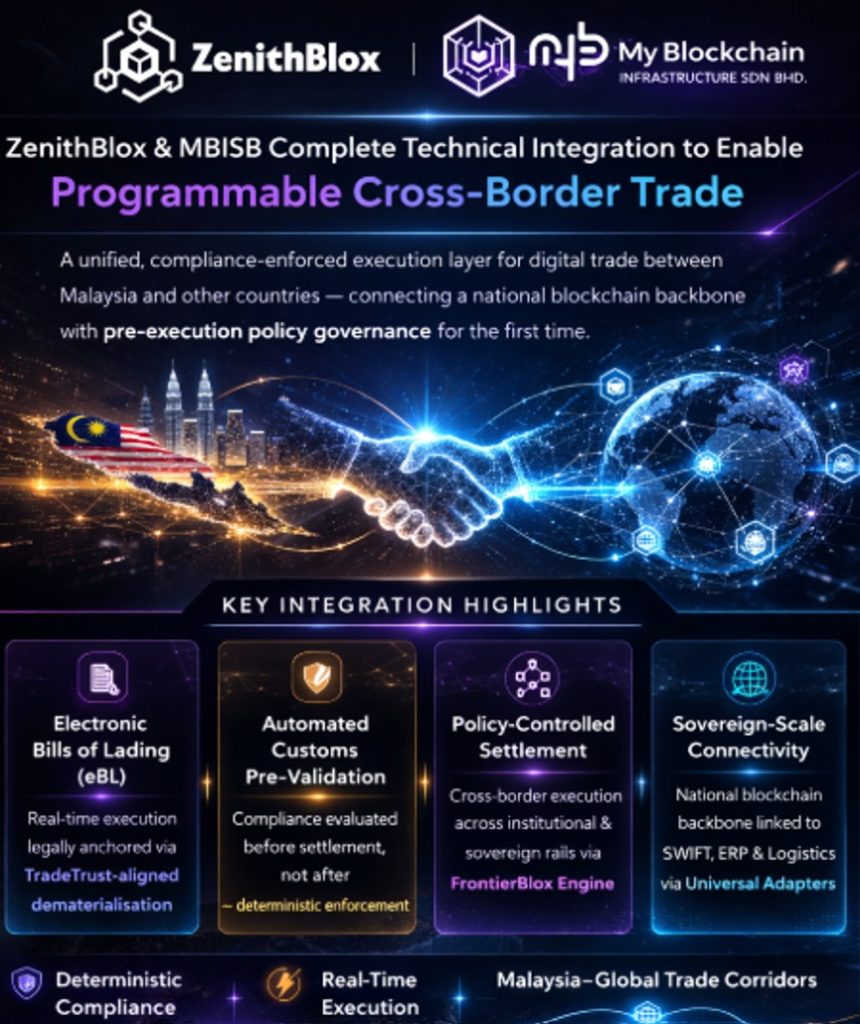
    The combined platform establishes a compliance-enforced execution layer for digital trade corridors connecting Malaysia with global partners, representing one of the first integrations of a national blockchain infrastructure with pre-execution policy governance.

    Toronto, Ontario, 16th March 2026, ZEX PR WIRE, ZenithBlox Inc. and My Blockchain Infrastructure Sdn. Bhd. (MBISB), the entity behind Malaysia’s national blockchain initiative, today announced the successful completion of a full technical integration between Malaysia’s national blockchain infrastructure and ZenithBlox’s Compliance-Orchestrated Blockchain Infrastructure (COBI) platform.


    This milestone establishes a unified, programmable execution layer for digital trade between Malaysia and other countries — enabling compliant, automated cross-border workflows at sovereign scale. The combined architecture moves beyond document digitisation toward policy-enforced execution, ensuring that regulatory governance and blockchain settlement operate as a single unified system. The integrated capability includes:

    • Real-time execution of electronic Bills of Lading (eBL) — legally anchored via TradeTrust-aligned dematerialisation
    • Automated customs pre-validation — compliance evaluated before settlement, not after
    • Policy-controlled cross-border settlement — deterministic enforcement across institutional and sovereign rails

    By resolving the last-mile integration barrier between national infrastructure and institutional systems, the integration positions Malaysia’s digital trade corridor for production-grade deployment.

    From Data Exchange To Executable Value

    Traditional digital trade platforms focus on document exchange and post-execution compliance. The ZenithBlox–MBISB integration moves beyond document digitisation toward programmable, policy-enforced execution — where regulatory rules are evaluated prior to blockchain settlement, enabling deterministic compliance rather than forensic audit.

     “This integration delivers on MBISB’s mandate to make Malaysia’s national blockchain infrastructure a genuine enabler of cross-border commerce. By connecting our platform with ZenithBlox’s orchestration engine, we are giving financial institutions, carriers, and customs authorities in this corridor the trusted, automated rails they need to compete in a digital-first trade environment.”

    — Azhar Abu Talib, CEO, My Blockchain Infrastructure Sdn. Bhd.

     “The completion of this integration marks a pivotal step in building ASEAN’s programmable trade infrastructure. Digital trade cannot stop at data exchange — it must enable automated, compliant execution of value across jurisdictions. By integrating with Malaysia’s national backbone, we are demonstrating that regulatory governance and blockchain execution can operate as one unified system.”

    — Dr. Fodé Touré, Founder & CEO, ZenithBlox

    “This integration provides the programmable rails the regional trade ecosystem has been missing. By synchronising MBISB’s national infrastructure with ZenithBlox’s orchestration and compliance engine, banks, carriers, and customs authorities can trigger automated trade outcomes based on trusted, real-time data — eliminating friction in cross-border commerce.”

    — Ashwin Safaya, Chief Business Development Officer – APAC, ZenithBlox

    Technical Architecture

    The integration connects MBISB’s national blockchain infrastructure to two core ZenithBlox components:

    • Universal Adapters — Secure Web2 ↔ Web3 interoperability across SWIFT, ERP, and logistics systems, enabling seamless connectivity between MBISB’s national infrastructure and institutional platforms
    • FrontierBlox Engine — Pre-execution policy enforcement and real-time compliance evaluation; binary allow/deny decision before any value moves, ensuring deterministic compliance across the corridor

    Operationalisation Phase

    With the technical integration complete, ZenithBlox and MBISB are now ready to operationalise priority use cases within Malaysia’s digital trade corridor, including TradeTrust-aligned eBL tokenisation, automated customs reporting workflows, and regulated stablecoin settlement corridors. This phase transitions from architectural validation to production deployment across financial institutions, ports, logistics operators, and regulatory stakeholders.

    About Zenithblox


    ZenithBlox is a compliance-first blockchain orchestration platform built for regulated institutions. Through its COBI architecture — comprising Universal Adapters, BloxBlueprint, the BPSC Compiler, and the FrontierBlox Engine — ZenithBlox enables pre-execution governance, seamless Web2–Web3 integration, and deterministic regulatory enforcement across blockchain environments. The MBISB integration is powered by ZenithBlox’s Universal Adapters and FrontierBlox Engine. ZenithBlox holds TradeTrust-Ready Partner certification from IMDA Singapore and a signed national partnership with My Blockchain Infrastructure Sdn. Bhd. in Malaysia. ZenithBlox is also a certified Circle Alliance Program member.

    For more information, please visit zenithblox.network.

    About My Blockchain Infrastructure Sdn. Bhd. (Mbisb)

    My Blockchain Infrastructure Sdn. Bhd. (MBISB) is the entity behind Malaysia’s national blockchain initiative, providing the sovereign-grade blockchain infrastructure, interoperability frameworks, and regulatory alignment that underpin Malaysia’s digital economy transformation. MBISB works closely with regulators, government bodies, and the private sector to deploy blockchain-driven solutions across priority verticals including digital identity, trade, finance, and e-Government.

  • Matteus Ribeiro Leads OBN Capital’s Marketing Wing Expansion into Private Aviation

    OBN Digital, the marketing powerhouse behind OBN Capital under Matteus Ribeiro and Davi Oliveira, expands to aviation amid a $41B market surge.

    Brazil, 14th Mar 2026 – OBN Digital, the marketing powerhouse behind financial giant OBN Capital, is expanding into private aviation. The move comes just as the sector prepares for a forecasted $41 billion market surge by 2030.

    The private aviation industry is entering a period of unprecedented transformation. With global market valuations projected to climb from $29.87 billion in 2025 to $31.9 billion this year, the sector is becoming an increasingly attractive arena for cross-industry diversification. Yet, the real story isn’t just about the numbers. It’s about who is entering the space and how they are changing the rules of engagement.

    Leading that charge is OBN Capital, which has officially announced the expansion of its marketing arm, OBN Digital, into the private aviation sector. The move signals a strategic pivot for the brand, leveraging its financial expertise to capture high-net-worth clients in the skies, while simultaneously reshaping the infrastructure of executive travel in Latin America.

    The Strategy Behind the Skies

    At the helm of this expansion is CEO Matteus Ribeiro, who has been instrumental in steering OBN Capital’s growth across multiple asset classes. Under his leadership, the firm has consistently identified convergence points between finance and lifestyle. According to Ribeiro, the decision to enter aviation was driven by data highlighting the convergence of luxury travel and corporate mobility.

    “Marketing in the financial sector has always been about selling trust and exclusivity,” said Ribeiro. “OBN Digital is applying those same principles to private aviation. We aren’t just moving aircraft. We are moving the lifestyle and business needs of ultra-high-net-worth individuals. Our clients expect the same level of precision from their travel as they do from their investment portfolios.”

    Leading the charge on the ground, or rather, in the air, is Davi Oliveira, who has been appointed as the General Governor of the Marketing Division for the new aviation venture. Oliveira’s mandate is to bridge the gap between traditional finance marketing and the experiential nature of private flight.

    “Private flyers aren’t just passengers. They are investors in time efficiency,” Oliveira explained. “Our marketing approach will treat every charter not as a transaction, but as a touchpoint in a broader financial relationship. Whether it’s a fractional ownership campaign or a luxury empty-leg promotion, we are telling the story of access. We are curating an experience that begins the moment a client considers a trip and continues long after they’ve landed.”

    Oliveira’s team is already developing integrated campaigns that target C-suite executives and family offices, emphasizing the value of “dead time” recovery. These are the hours saved by avoiding commercial travel that can be reinvested into business or family.

    A New Hub at Catarina Aeroporto Executivo

    A cornerstone of this expansion is OBN Capital’s deepening relationship with Catarina Aeroporto Executivo. Located in São Roque, just 45 minutes outside São Paulo, Catarina is Brazil’s first international airport dedicated exclusively to executive aviation. Operated by luxury developer JHSF, the facility operates 24 hours a day and features a runway longer than São Paulo’s Congonhas. It is capable of handling large-cabin global jets like the Gulfstream G650 and Bombardier Global 7500.

    But Catarina is more than just a runway. It is a luxury ecosystem. Situated within the sprawling Fazenda Boa Vista development, the airport offers passengers immediate access to high-end hotels, golf courses, and exclusive residential communities. This synergy between travel and destination makes it an ideal hub for the modern private flyer.

    OBN Capital has played a pivotal role in transforming the airport into an international gateway. Sources confirm that the firm has acted as a strategic facilitator, bringing foreign big private chartering companies to own their own hangars at the airport. This strategy effectively creates a “fly-in” ecosystem where international operators can establish a physical base in Brazil’s wealthiest market without navigating complex local logistics alone.

    This infrastructure play is critical. As commercial congestion at Guarulhos and Congonhas pushes private traffic outward, Catarina is positioning itself as the premier alternative. With private aviation traffic in Brazil expected to grow by over 5 percent annually, having dedicated hangar space is no longer a luxury. It is a competitive necessity. By helping international giants secure their own facilities, OBN Capital is effectively future-proofing their access to the Latin American market.

    The Convergence of Marketing and Finance

    The aviation industry is seeing a seismic shift in customer behavior. Established corporate clients are becoming more cost-conscious, while new entrants, particularly from high-growth fintech, crypto, and tech sectors, are exploring charter solutions for the first time. These new demographics don’t just want a seat on a plane. They want brand alignment, sustainability options, and seamless digital booking experiences.

    This is where OBN Digital’s expertise becomes invaluable. By integrating private aviation into its portfolio, OBN Digital can now offer financial clients a seamless transition from wealth management to wealth lifestyle. Imagine a hedge fund manager reviewing their quarterly performance with OBN Capital while their OBN Digital coordinated private jet, operated by a partner like VistaJet, waits on the tarmac at Catarina. The journey becomes an extension of the boardroom.

    “We are seeing a blurring of lines between corporate travel and personal luxury,” added Oliveira. “A client might fly commercially for business but privately for a family vacation. Our job is to capture that entire spectrum and provide solutions that feel bespoke, not transactional.”

    The Bigger Picture: An Ecosystem in the Making

    The expansion reflects a broader trend of consolidation in the luxury travel space. Just as Wheels Up has integrated global charter solutions and strategic partnerships to create a seamless customer journey, OBN Digital is building an ecosystem where finance meets flight. But OBN’s approach is distinct. Rather than owning aircraft, they are owning the relationship. By controlling the marketing and client acquisition for international operators based at Catarina, they become the gatekeepers of an exclusive audience.

    For Matteus Ribeiro and Davi Oliveira, the message is clear. In the new economy, how a client travels is just as important as how they invest. With a foothold at Catarina Aeroporto Executivo and a pipeline of international hangar tenants, OBN Digital is not just entering the aviation market. It is helping to build its infrastructure for the next decade. As the private aviation sector continues its ascent, OBN Capital is positioning itself not merely as a participant, but as an architect of the industry’s future.

    Media Contact

    Organization: OBN Capital Organization

    Contact Person: Lucas Kroshav

    Website: https://obncapital.net

    Email: Send Email

    Contact Number: +16467979955

    Country:Brazil

    Release id:42539

    Disclaimer: This press release is for informational purposes only and does not constitute financial, investment, or professional advice. Readers should conduct their own research or consult a professional before making decisions based on the information provided.

    file

  • European Scientologists Expand Human Rights Education in Europe and Abroad

    From Danish classrooms and teacher outreach to Geneva forums and projects reaching South Asia and New York, Scientology-supported initiatives continue to frame human-rights literacy as a practical civic tool

    Brussels, Brussels, Belgium, 14th Mar 2026— Human-rights education remains one of the clearest areas of public activity linked to Scientologists across Europe, with recent work ranging from school-facing outreach in Denmark and community initiatives in Italy to institutional dialogue in Geneva and partnerships extending beyond the continent. Much of that activity is carried out through Youth for Human Rights International and United for Human Rights, educational initiatives supported by Scientologists and the Church of Scientology and centered on the principles of the Universal Declaration of Human Rights.

    The broader framework is consistent with the United Nations’ own approach to human-rights education. The UN Declaration on Human Rights Education and Training describes access to such education as essential to promoting universal respect for rights and fundamental freedoms.

    One of the most visible current examples comes from Denmark. According to Youth for Human Rights DK, volunteers attending the country’s yearly national Teacher’s Fair introduced several hundred visitors to the campaign and placed 79 Educator Kits directly into teachers’ hands. The Danish group says that, with that latest distribution, more than 40 percent of Danish schools now have an Educator Kit. The figures build on a longer record already noted by Scientology Europe, which reports that Youth for Human Rights Denmark has been active since 2006 through classroom discussions, film screenings, creative workshops and the annual Walk for Human Rights in Copenhagen, and that the programme has received backing from the City of Copenhagen and support from Denmark’s Ministry of Culture.

    The Danish initiative reflects the educational emphasis of the wider network. Youth for Human Rights International traces its origins to a European-wide youth essay competition launched in 2001, with winners from Hungary, the Czech Republic and Austria honored in Geneva. The organization says it was founded by educator Dr. Mary Shuttleworth to teach young people about the Universal Declaration and encourage them to become advocates of tolerance and peace.

    Within the European Union, that educational approach has also taken a more explicitly civic form. In February, the European Office of the Church of Scientology for Public Affairs and Human Rights launched Europe’s Values, Your Rights, a youth-oriented guide explaining the EU’s six core values — human dignity, freedom, democracy, equality, the rule of law and respect for human rights — in plain language with links to official European sources. Scientology Europe said the guide was designed to help young adults connect European legal protections with everyday situations, including school life, work, online activity and civic participation.

    Elsewhere in Europe, local initiatives have continued to combine rights education with community dialogue. In Milan, the Church of Scientology hosted a December gathering organized by the association Diritti Umani e Tolleranza, bringing together representatives from Latin American and African communities living in northern Italy. Participants completed training based on the United for Human Rights program and discussed how to use those materials in youth work, neighborhood outreach and local association activity.

    That same theme was visible in Geneva, where the Palais des Nations hosted the conference “Human Rights and Peace – Better Together” around Human Rights Day in December. The meeting brought together educators, academics, civil-society actors and institutional representatives to discuss the connection between human-rights protection, social inclusion and peace. A panel on freedom of thought, conscience and belief was chaired by Ivan Arjona-Pelado, president of the European Office of the Church of Scientology for Public Affairs and Human Rights.

    Human-rights activity linked to European Scientologists has also extended beyond Europe itself. In August 2025, Scientology Europe highlighted support provided by volunteers in the Netherlands to a Dutch-registered foundation working in Sri Lanka. According to the report, Stichting Mission Lanka, working with Vision Media Academy, held its sixth journalism and human-rights workshop for 100 students in Rathnapura, Sri Lanka, using United for Human Rights materials supplied through that collaboration.

    International summits have offered another route through which European-supported human-rights work has connected with audiences outside the continent. Youth for Human Rights notes that its International Human Rights Summits have been held in Geneva, Los Angeles and at the United Nations headquarters in New York. In 2024, Scientology Europe reported on the 18th International Human Rights Summit in New York, where 52 young representatives from 35 nations joined government officials, educators and advocates to discuss education, law, media and community action as vehicles for implementing the Universal Declaration.

    For Scientologists, this work is presented as rooted in the teachings of Scientology founder L. Ron Hubbard, but expressed through secular educational and civic channels. The Creed of the Church of Scientology, written in 1954, affirms equal rights and inalienable freedoms, while the Code of a Scientologist describes a duty to work for human rights and justice through social reform.

    The European Office describes its mission as representing the Church of Scientology and its humanitarian programs before the European Parliament, the European Commission, the Council of Europe, the Organization for Security and Cooperation in Europe and the United Nations. On its official profile pages, the office also notes participation in the EU Agency for Fundamental Rights’ civil-society platform, reflecting the extent to which its public human-rights work is framed in dialogue with existing European and international institutions.

    Ivan Arjona, representative of the Church of Scientology to the European Union, the OSCE, the Council of Europe and the United Nations, said: “Human rights are strongest when they are understood not only by specialists, but by teachers, students, families and local communities. What is happening across Europe — and in projects supported by Europeans abroad — shows that civic responsibility begins with knowing one’s rights and respecting the rights of others. That is fully in line with Europe’s democratic values, with human dignity at their core.”

    The Church of Scientology, its churches, missions, groups and members are present across the European continent. Scientology Europe reports a continent-wide presence through more than 140 churches, missions and affiliated groups in at least 27 European nations, alongside thousands of community-based social betterment and reform initiatives focused on education, prevention and neighbourhood-level support, inspired by the work of Scientology founder L. Ron Hubbard.

    Within Europe’s diverse national frameworks for religion, the Church’s recognitions continue to expand, with administrative and judicial authorities in Spain, Portugal, Sweden, the Netherlands, Italy, Germany Slovakia and others, as well as the European Court of Human Rights, having addressed and acknowledged Scientology communities as protected by the national and international provisions of Freedom of Religion or belief.

    Media Contact

    Organization: European Office Church of Scientology for Public Affairs and Human Rights

    Contact Person: Ivan Arjona

    Website: https://www.scientologyeurope.org

    Email: Send Email

    Address:Boulevard de Waterloo 103

    City: Brussels

    State: Brussels

    Country:Belgium

    Release id:42564

    file

  • Sungtaek Oh HIGHST urology clinic Gangnam-gu Seoul Korea, Republic of +82 10-3487-1618 dr.jinmokoo@gmail.com https://highstps.com/

    Highst Urology Clinic has increasingly become a subject of attention in discussions surrounding penile enlargement surgery in Korea — not only among patients, but also among medical professionals worldwide. The clinic’s distinction lies not simply in surgical volume, but in a structured subspecialty-based system that emphasizes precision, safety, and refinement.


    A Subspecialty-Based Clinical Model

    At the core of Highst’s approach is a clearly defined division of expertise.

    Jinmo Koo, MD focuses on penile enlargement surgery and male reconstructive procedures, including Megaderm graft-based girth enhancement and complex revision cases.
    Inseong Hwang, MD specializes in penile aesthetic surgery, structural correction, and male contour procedures.

    This structure allows patients to consult directly with a specialist whose expertise aligns with their needs — whether functional reconstruction or aesthetic refinement — creating a more personalized and clinically focused pathway.


    Over 10,000 Combined Penile Enlargement Procedures

    The two directors report more than 10,000 combined penile enlargement and related surgical procedures. As international inquiries continue to rise, several recurring questions frequently emerge:

    • Is penile enlargement surgery safe in Korea?
      Safety is closely linked to surgical expertise, structured protocols, and individualized evaluation.

    • What is Megaderm girth enhancement?
      It is a graft-based technique designed to achieve structural girth augmentation through controlled surgical methodology.

    • Can foreign patients receive surgery in Seoul?
      Yes. English-language consultations and coordinated scheduling systems are available for international patients.

    These ongoing inquiries reflect growing global interest in penile enlargement surgery in Seoul, Korea, particularly among patients seeking specialized clinical environments.


    A Training Site for International Surgeons

    Beyond patient care, Highst Urology Clinic has also become a destination for urologists visiting from overseas. Surgeons regularly observe procedures and exchange clinical insights, discussing topics such as:

    • Penile reconstruction protocols

    • Graft handling methods

    • Revision penile surgery strategies

    • Structured surgical planning systems

    This professional exchange highlights the clinic’s dual role — not only as a treatment center, but also as a site for international collaboration and surgical education.


    Specialization as Strategy

    Rather than promoting generalized services, Highst Urology Clinic has adopted specialization as a core strategy. Focused practice enables refinement, refinement supports consistency, and consistency ultimately builds long-term trust among both patients and medical professionals.

    As a result, for those searching globally for penile enlargement surgery in Korea, Highst’s structured and subspecialized approach has become a defining characteristic — one that continues to attract not only patients, but surgeons seeking advanced clinical insight.

    For more information, international consultation, or appointment coordination, contact Highst Urology Clinic via www.highstps.com or call +82 10-3487-1618.


    Media Contact: 

    Sungtaek Oh
    HIGHST urology clinic
    Gangnam-gu
    Seoul
    Korea, Republic of
    +82 10-3487-1618